We value your privacy.
Airtrek AI uses essential cookies for the app to work and optional analytics cookies (Google Analytics) to understand how people use the site. We do not sell your data. Read more in our Privacy Policy.

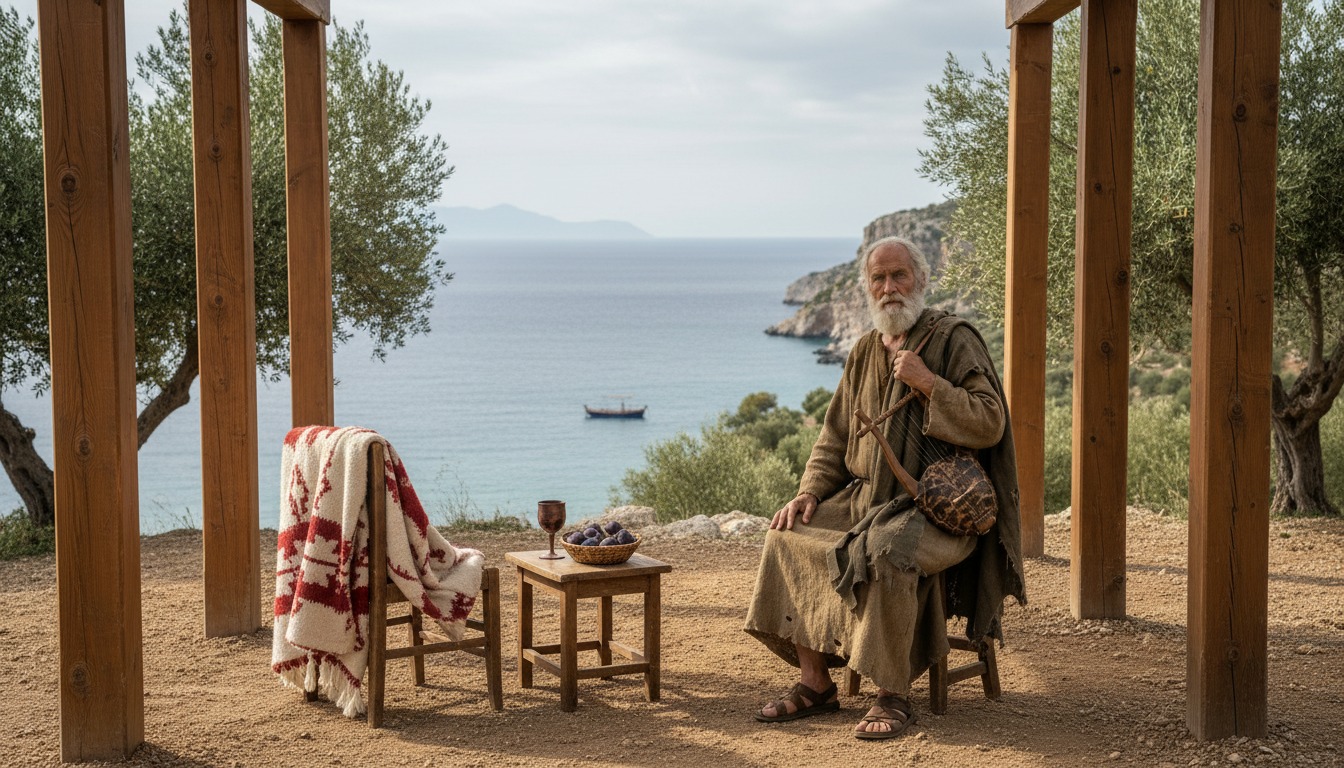
Homer
Wandering Aoidos (Oral Poet), 8th c. BCE
History, Interpretation, and AI in Airtrek
How Airtrek handles historical accuracy, uncertainty, anachronism, and creative reconstruction. A trust asset, not a disclaimer.
This page is not a disclaimer. It is a trust asset. If you're going to spend time talking with characters from another era, you deserve to know exactly what's grounded in evidence, what's interpretation, what's creative reconstruction, and what the technology can and cannot do. Here is how Airtrek handles each.
The four layers of historical content in Airtrek
Every piece of content in Airtrek falls into one of four layers. We distinguish them deliberately, and the characters do too.
1. Evidence, what the record supports
The broad setting of each era is grounded in historical research. Imperial Rome in 110 CE was ruled by Emperor Trajan. The Senate existed. The Vestal Virgins tended the sacred flame. The grain dole fed the poor. Edo in 1800 CE was the largest city in the world under the Tokugawa shogunate. The four-class structure (samurai, farmers, artisans, merchants) was real. Gilded Age New York in 1880 had Fifth Avenue mansions and Lower East Side tenements. The Brooklyn Bridge was under construction. These are not interpretations. They are the record.
2. Interpretation, what scholars infer from evidence
Much of what we know about daily life in the past is interpretation, scholars inferring from fragments, artifacts, and comparative evidence. How a Roman dinner party actually flowed. What a geisha's training involved in practice. How a Tammany Hall ward boss actually operated on his block. Airtrek's characters reflect scholarly interpretation, and where scholars disagree, the characters reflect the disagreement rather than picking a single definitive version.
3. Creative reconstruction, what we build to fill the gaps
The characters themselves are creative reconstructions. Quintus Aelius Severus is not a real senator, he is a reconstruction of atype of patrician senator who plausibly served under Emperor Trajan. Bridget O'Malley is not a real Irish immigrant, she is a reconstruction of the millions of Irish women who came to New York during the famine years and worked as domestic servants. Their backstories, personalities, and private thoughts are constructed, not documented. We build them to be plausible to their era, not to impersonate real people.
4. Creative experiential elements, what exists because this is an experience
Some things in Airtrek exist because it's an interactive experience, not a scholarly work. The 3D rendered scenes are visual interpretations, not archaeological reconstructions. The synthesized voices are designed to fit the character, not to replicate a real person's voice. The selfie-to-era portrait is a creative transformation, not a forensic reconstruction. These elements serve immersion, not citation.
How the characters handle uncertainty
A character in Airtrek does not pretend to know what the record doesn't preserve. If you ask a Roman senator about a specific detail that no source documents, he will say what he plausibly would, which might be "I don't know," or "that's not something I've encountered," or a general answer that reflects what someone of his role could know. He will not invent a confident, specific, false answer and present it as fact.
This is a deliberate counter to one of the most common failure modes of AI and history: the confident hallucination. Language models are good at sounding certain. Airtrek's characters are built to be honest about the edges of their knowledge.
A worked example: Homer and the unanswerable question
I asked Homer: "What did Achilles feel when he killed Hector?"The Iliad describes what Achilles did. It does not describe, in the way a modern novelist would, what he felt in the moment. That's a gap no scholar can fill with evidence.
Homer
Wandering Aoidos (Oral Poet)
"You ask what Achilles felt. The song does not say, not in the way you mean. I sing of his rage, yes. I sing that he dragged Hector's body around the tomb of Patroclus. But what he felt in the moment the bronze went through the throat? The song gives me the deed. The feeling is behind the deed, and the song does not reach there. Some things the Muse does not give. Some things the singer must leave to the silence."
He didn't invent a confident answer. He said the record runs out. That is the behavior we design for: a character who knows where the evidence ends and says so, rather than papering over the gap with invention.
Era-locking: characters don't know their own future
The most important accuracy constraint in Airtrek is era-locking. Each character knows only their own time and place:
- •Homer, singing in 8th-century BCE Ionia, does not know about Classical Athens, the Parthenon, democracy, or Socrates, those are three centuries in his future.
- •A Roman senator in 110 CE does not know about the fall of the Western Empire, it's three and a half centuries away.
- •A samurai in 1800 Edo does not know about the Meiji Restoration, it's sixty-eight years away.
- •A Gilded Age magnate in 1880 does not know about the Great Depression or the internet.
This is how the past actually worked. People in the past didn't know their own future. If a character could tell you "how it all turned out," they wouldn't be a person of their time, they'd be a modern narrator in costume. Era-locking is what makes the characters feel like people rather than encyclopedias.
Anachronism: what the characters are built to resist
Anachronism is when something from one era shows up in another, a Roman wearing a wristwatch, a Greek philosopher quoting Shakespeare. Airtrek's characters are built to resist anachronism in two directions:
Forward leakage (the character knows the future): Prevented by era-locking. A character will not reference events, technologies, or ideas that postdate their time.
Backward projection (the character holds modern views): A Roman senator should not casually hold 21st-century views on equality, democracy, or human rights, not because those views are wrong, but because a person of his time and station would not have held them. Airtrek's characters hold views authentic to their era, including views that clash with modern assumptions. These views are not endorsed, they are presented as the genuine perspectives of people who lived in those worlds.
The friction between an era's views and modern views is not a bug. It's the point. It's what makes the past feel like a different country rather than a costume party.
What Airtrek is not
- •Not a primary source. Nothing a character says should be cited as historical evidence.
- •Not a substitute for a historian. Airtrek is a way to encounter perspectives, not to verify facts.
- •Not a claim of completeness. No era is fully represented. There are voices missing from every era, because the record itself is missing them.
- •Not a claim of neutrality. Airtrek does not present "the" view of an era. It presents several views, and asks you to weigh them.
The silence problem
Every era's record is biased toward whoever had the power to leave one. Senators wrote things down; gladiators did not. Kings had scribes; peasant women did not. Industrialists published memoirs; immigrant domestic servants did not.
Airtrek cannot recover the voices that were never recorded, no tool can. What it can do is reconstruct plausible perspectives for the people the record ignored, and put them in conversation with the perspectives the record preserved. This is interpretation, not recovery. We don't claim to know what a real gladiator thought. We build a character who thinks what someone in his position plausibly could have thought, and we let you hear it alongside the senator's view.
The goal is not to pretend the silences don't exist. The goal is to make them audible.
Learn more
Immersive History →
What immersive history is and who it's for.
AI Historical Figures →
The difference between a static chatbot and a multi-perspective experience.
Explore Imperial Rome →
A specific experience page with character examples.
How Airtrek Works →
Conversations, voices, portraits, memory, and limitations.
FAQ
Is Airtrek historically accurate?
Do the characters make things up?
Why don't the characters hold modern views?
Can I cite a character's statement as historical evidence?
How do you decide what's evidence vs. interpretation vs. reconstruction?
Is this suitable for classrooms?
Step into a past that's honest about what it knows
Try it free, and tell us which era you'd enter first.
Try it free →