We value your privacy.
Airtrek AI uses essential cookies for the app to work and optional analytics cookies (Google Analytics) to understand how people use the site. We do not sell your data. Read more in our Privacy Policy.

How Airtrek Creates Immersive Historical Experiences
A complete visual walkthrough: meet Lyra, chat with era-locked characters, generate portraits, collect passport stamps, create your own characters, and request historical figures.
Airtrek is an immersive AI history experience. This page is the complete guide, how to navigate, who Lyra is, how characters work, how voice and images and tokens fit together, how to create your own characters, and how to request historical figures. If you want to know what the experience is before you try it, this is the page.
1. Meet Lyra, Your AI Travel Guide
When you sign in, you arrive at the Spaceship , an interactive command center where you meet Lyra, your AI travel guide. Lyra is the only character who exists outside of time. She knows about every era and location, and she helps you choose where to go.
Tell Lyra where you want to travel: "I want to visit Ancient Rome" or "Take me to Gilded Age New York." She'll suggest a destination, give you a brief historical intro, and open a portal to that time and place. She remembers your past trips and can suggest new destinations based on where you've already been.
Lyra greets you in the Spaceship and helps you choose your destination.
2. Arrive in a Living Scene
You pick a location and time period, Imperial Rome under Trajan, Ancient Greece in the age of Homeric song, Edo Japan under the Tokugawa shogunate, Gilded Age New York, Ancient Egypt under Ramesses II, and more. You arrive in a panoramic scene of that world: the Roman Forum, the agora of an Ionian city, the harbor of 1880s Manhattan.
You can look around the scene and navigate between views, the harbor, the hills, the great hall, using the directional buttons. As you converse with characters, they can generate new scenes reflecting what you're discussing, their workshop, a temple, a marketplace. The world expands through conversation. Some locations also have a sibling pack, a second trio of characters at the same location, which you can switch to using the "Meet [name]" button in the chat header.

The Roman Forum, your arrival scene in Ancient Rome, 110 CE.
The scene is a backdrop, not a sandbox. It sets the place. The people you meet are what make it feel inhabited.
3. Talk with Characters Who Live in That Era
The core of Airtrek is conversation. When you arrive at a destination, you meet three characters, people who could genuinely live in that time and place. A senator, a noblewoman, a merchant. A pharaoh, a scribe, a dancer. Each one has:
- •A specific role and station, patrician or freedman, samurai or merchant, magnate or immigrant.
- •A personality and speaking style, formal or conversational, poetic or direct, weary or circumspect.
- •Firm views, opinions they hold because their culture held them, even when those views clash with modern assumptions.
- •Blind spots, things they cannot see because their society didn't question them.
- •A voice, each character has a distinct synthesized voice, so you hear them as well as read them.
The characters are not one all-knowing narrator. They are multiple people with different perspectives, and the point is to talk to several of them and notice where they disagree.
The three characters in each location know each other. They live in the same city, walk the same streets, and move in overlapping circles. The senator and the merchant have done business. The noblewoman and the senator move in the same social world. They have opinions about each other, histories together, and relationships that predate your arrival.
This means you can create storylines that draw them all in. Tell the merchant you heard a rumor at the senator's dinner, and he'll react to something his colleague supposedly said. Ask the noblewoman what she thinks of the merchant's trade ambitions, and she'll answer from her own experience of him. The characters reference each other naturally because they're part of the same community, not three strangers waiting in separate rooms.
And as you talk to all three, they get to know you. They remember what you told each of them, they form impressions of you as a traveler, and those impressions carry over when you switch to another character in the same location. You become part of their story, and they become part of yours.
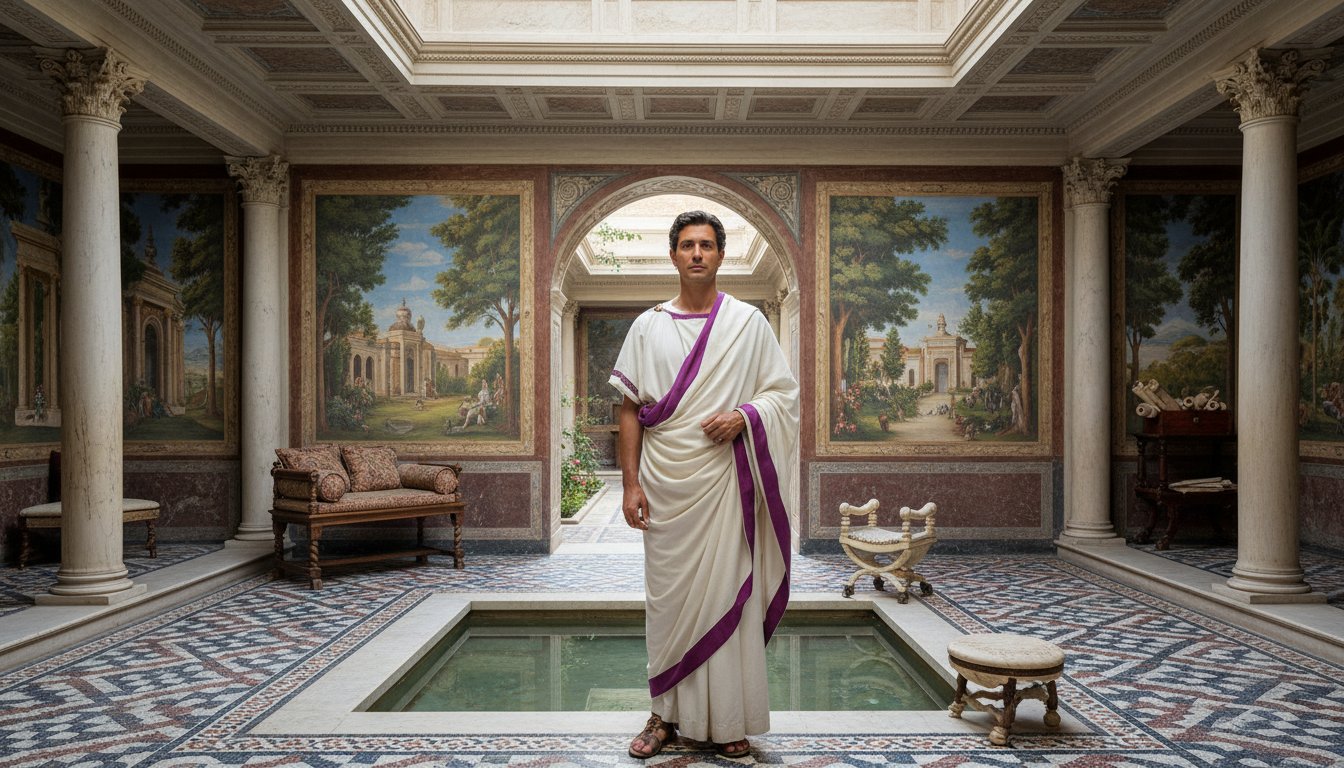
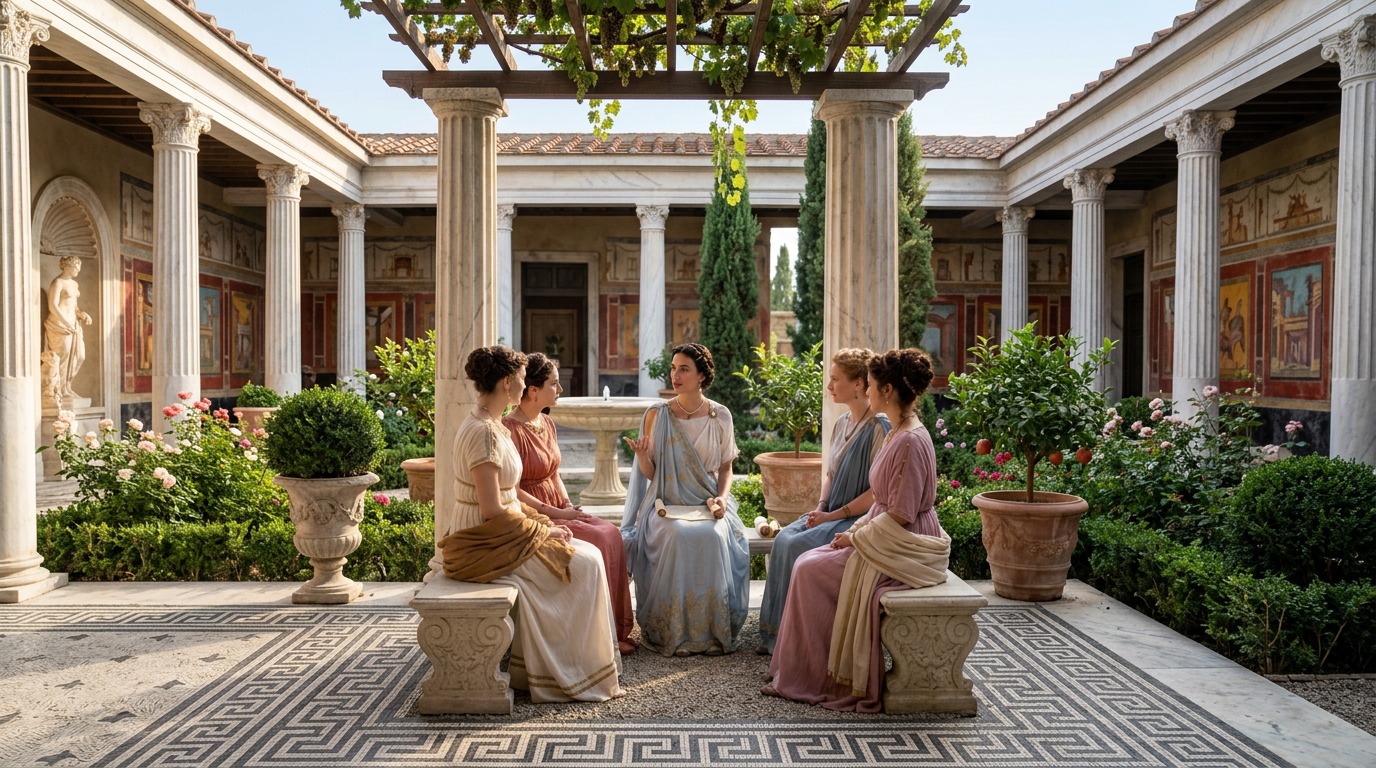
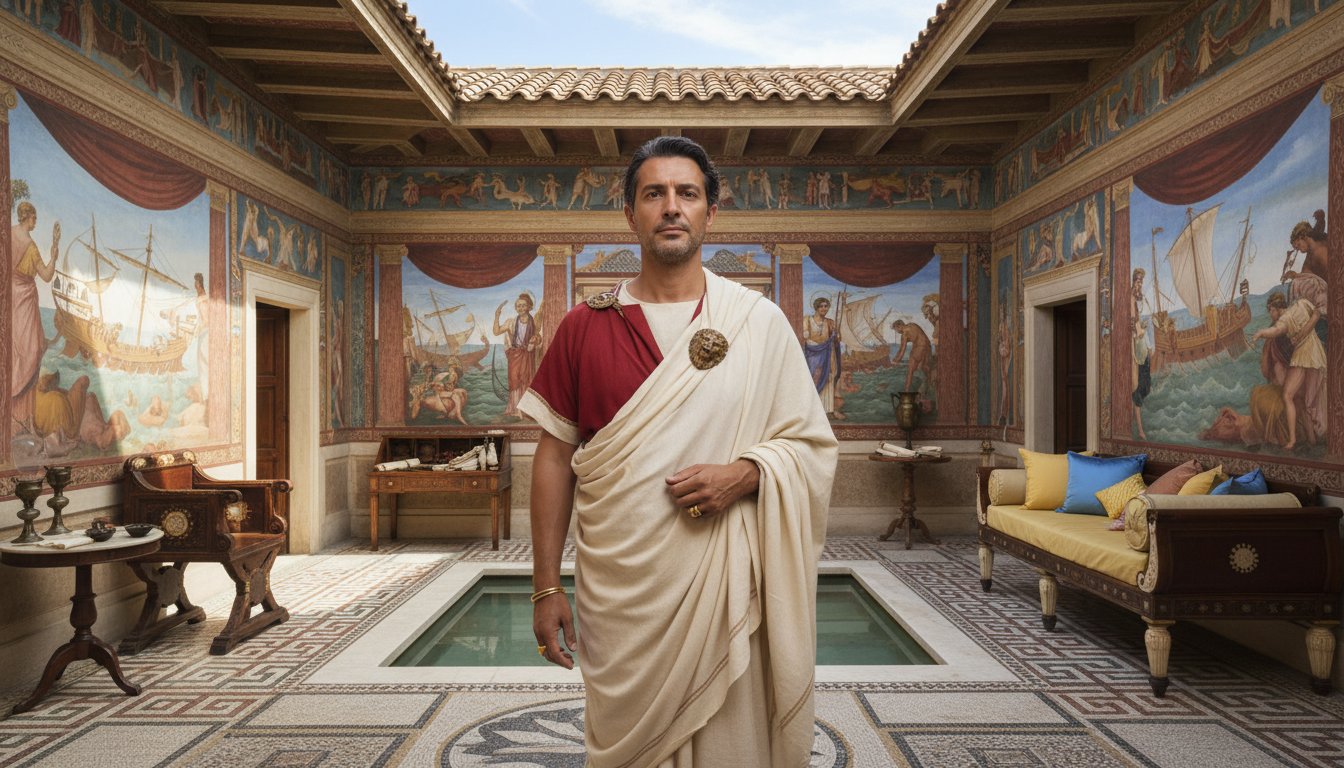
Three characters from Ancient Rome, each with a different perspective.
4. Each Character Is Era-Locked
This is the most important design constraint in Airtrek, and the one most AI history tools get wrong: each character knows only their own time and place.
A Roman senator in 110 CE does not know about the fall of the empire, it hasn't happened yet. Homer, singing in 8th-century BCE Ionia, does not know about Classical Athens, because it's three centuries in his future. A samurai in 1800 Edo does not know about the Meiji Restoration. A Gilded Age magnate in 1880 does not know about the internet.
This is by design. It's how the past actually worked. People in the past didn't know their own future. If a character could tell you "how it all turned out," they wouldn't be a person of their time, they'd be a modern narrator wearing a costume. Airtrek's characters are people of their time, and that means their knowledge has edges.
5. Characters Remember You
When you talk with a character, the conversation is remembered. If you come back and talk to the same character again, they recall what you discussed. Because the three characters in a location know each other, they may also reference things you said to their companions, the merchant might mention the story you told the senator, the noblewoman might ask about the question you put to the merchant. This is persistent memory, it's what makes the world feel inhabited rather than reset every time you open it.
Lyra also remembers your past trips and can suggest new destinations based on where you've been. Memory is stored server-side and is tied to your account. You can read what's stored and delete it. See Historical Accuracy for how memory relates to consistency, and our Privacy Policy for the data details.
6. Hear Them Speak, Voice Is Free
Every character has a distinct synthesized voice. When they respond, you hear them speak as well as read their words. Voices are gendered and pitched to match the character's personality.
Voice synthesis is currently free. You can hear every character speak without spending any tokens. Chat is also always free. This may change in the future, but for now, talk and listen as much as you like.
Character introductions are pre-rendered and cached so they load instantly and cost nothing to play. Dynamic conversation responses are synthesized live. If the voice service is unavailable, the experience falls back to your browser's built-in speech synthesis so you still hear the character, we don't silently degrade the experience without telling you.
7. Speak with Characters in Their Native Language
Many characters can speak not only in authentically accented English, but also in the native language closest to what was (or is currently) spoken in their time and place. A Roman senator speaks Latin. A Florentine artisan speaks Italian. A Chengdu scholar speaks Mandarin. An Edo samurai speaks Japanese.
Use the language toggle in the chat header to switch between three modes:
- •English, characters speak in authentically accented English, era-appropriate in vocabulary and register.
- •Native, characters speak in their native language with native text, plus an English translation shown alongside. Ideal for language learners.
- •Native only, full immersion in the character's language with no translation. For when you want to feel like you're really there.
Not every character has a native language available yet, we're expanding coverage continuously. When a native language isn't available, the character speaks in accented English and the toggle reflects that.
8. Transform Your Selfie into a Person of That Era
You can upload or take a selfie, and Airtrek transforms it into a historically grounded portrait of you as a person of that time and place, a Roman citizen, a Greek of the heroic age, an Edo townsman, a Gilded Age New Yorker. The portrait is generated by an image model and styled to the era's clothing, setting, and visual language.
This is not a filter. It's a way of seeing yourself in the scene, of making the past feel like a place you arrived in rather than a page you're reading. Your raw selfie is stored encrypted on your device, not uploaded as plaintext. The server cannot decrypt it. Generated portraits are yours and are never added to the shared world.
9. Generate Images, How Tokens Work
You can also ask characters to generate scenes , images of their world, their daily life, their environment. Both selfie transformations and scene generation use tokens.
Scenes are also auto-generated as you converse. Every three messages in a conversation, a new image is created automatically based on what you and the character are discussing. You don't have to do anything. The world visually updates around the conversation, so the scene reflects where the story has gone. You can also request an image at any time by asking the character to show you something.
You get 50 free tokens every week. Log in to claim them, they don't accumulate. Chat and voice are always free. When you run out of weekly tokens, you can pick up a Coin Pouch from the Account page to generate more selfies and scenes.
10. Collect Passport Stamps
Every destination you visit earns a passport stamp , a visual record of your travels through time. Your passport tracks:
- •Locations visited, every era you've traveled to
- •Characters met, every person you've talked with
- •Portraits gallery, your era-styled selfies, downloadable anytime
View your passport from the Account page. You can download your portraits and delete your data at any time.
11. Create Your Own Characters
Want a character that doesn't exist yet? The Character Creator lets you design custom historical characters for any destination. Choose their social class, occupation, gender, age, and personality, or leave it blank for a surprise.
Single character: 25 tokens (you design one, two companions are auto-generated). Trio: 60 tokens (you design all three). Requires purchased tokens, weekly tokens don't apply.
Your created characters get AI-generated avatars, distinct voices, and are added to your personal collection. They also join the location as a Community Cast, other travelers can meet them too. After creating, use the "Chat with your cast" button to jump straight into a trek with your custom characters.
12. Request a Historical Figure
Want to chat with a specific real historical figure, a king, queen, emperor, or famous person? You can't create them yourself (the Character Creator generates plausible everyday people, not real historical individuals). Instead, you submit a request.
The difference:
Custom Characters = everyday people you design yourself (merchant, soldier, priestess). Generated instantly. Private to you + community cast. Costs 25–60 purchased tokens.
Historical Figure Requests = real, documented individuals (Julius Caesar, Hatshepsut). Our team curates them with verified biographical details. ~48hr turnaround. Free to request.
Submit requests from the Character Creator page. You'll see the status update (pending → in curation → ready) on the same page.
13. What Airtrek Does Not Do
- •Airtrek does not give you one authoritative answer. It gives you multiple perspectives and asks you to weigh them.
- •Airtrek does not impersonate real, documented individuals (unless requested and curated). Characters are reconstructions of plausible types, or figures from oral and literary tradition encountered as their culture understood them.
- •Airtrek does not let characters reference the future. Era-locking is enforced.
- •Airtrek does not silently fail. If a voice, image, or memory fallback kicks in, it's signaled to you.
- •Airtrek is not a primary source. It is a way to encounter the past as a world of perspectives, not a substitute for the historical record.
Multiple Perspectives in Practice
Ask a senator, a noblewoman, and a merchant in Imperial Rome the same question and you get three different answers, because they lived three different lives:
Quintus Aelius Severus
Senator
"The emperor's power is an instrument. Under Trajan it is a foundation. The office is the same. The man is not."
Julia
Noblewoman
"Power is not a tool to me. It is the weather I host my guests in. It decides whether a woman like me may read Greek philosophy without scandal."
Gaius
Merchant
"I'm richer than half the Senate, but I can't hold the highest offices because I'm equestrian, not patrician. The emperor's power is the ceiling I hit every day, no matter how much I've built."
This is not three attempts at the same correct answer. It's three genuinely different answers, because they're three genuinely different people.
Works on Your Phone, Install It Like an App
Airtrek is a Progressive Web App , it runs in your browser on desktop, tablet, or phone, with no app store download required. On mobile, you can install it to your home screen for a full-screen, native-app experience.
On iPhone: open Airtrek in Safari, tap the Share button, and select "Add to Home Screen." On Android: open in Chrome and tap "Install app" when prompted. Installing preserves your character memory locally so it survives between visits, the app behaves like a native installation without the app store.
Quick Reference
Learn more
Immersive History →
What immersive history is and who it's for.
AI Historical Figures →
The difference between a static chatbot and a multi-perspective experience.
Explore Imperial Rome →
A specific experience page with character examples.
Historical Accuracy →
How Airtrek handles evidence, anachronism, and creative reconstruction.