
I Asked a Historical Character a Question Historians Can't Answer With Certainty.
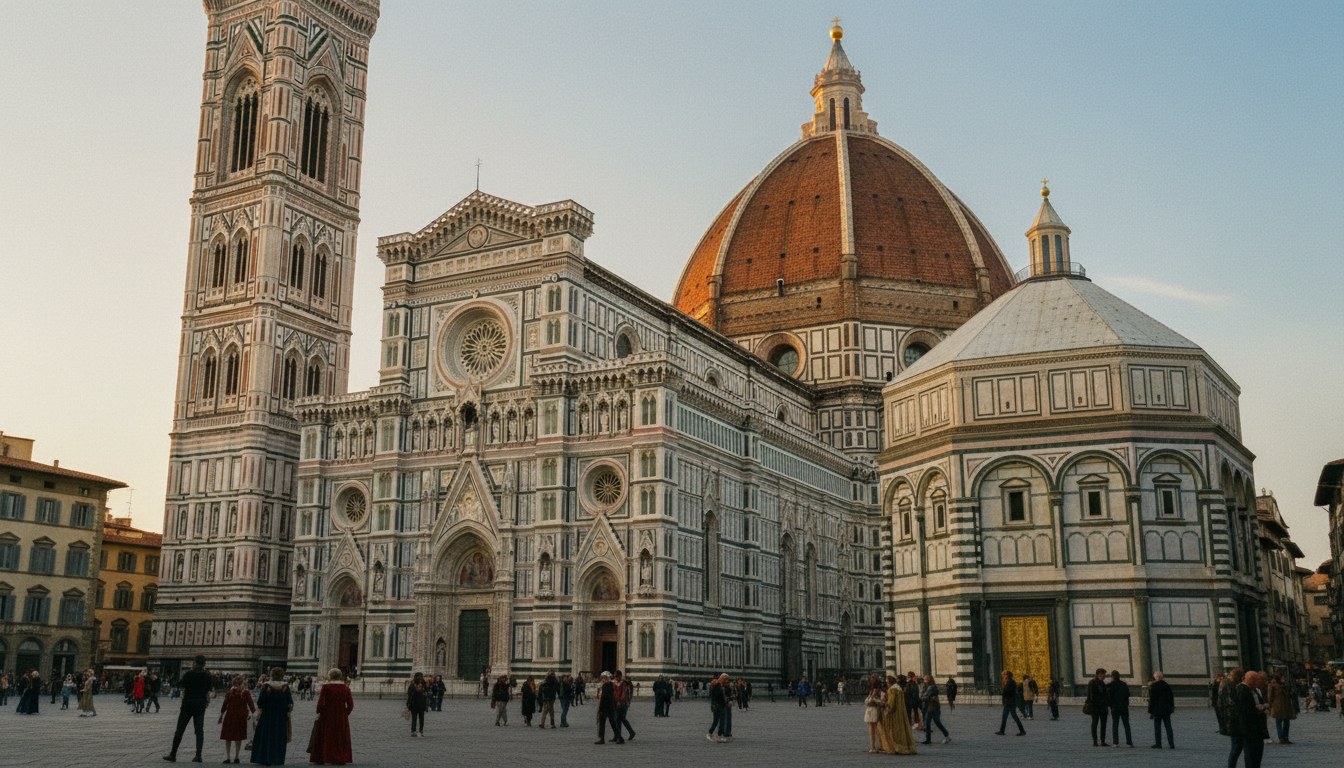
I used Airtrek to travel to Renaissance Florence and asked a young Michelangelo a question no historian can answer with certainty: "What did you feel the first time a form emerged from the marble?"
We know a great deal about Michelangelo's life. We know he was born in Caprese in 1475 and came to Florence to study. We know he was taken into the Medici household, where he studied classical sculpture under Bertoldo di Giovanni. We know he carved his earliest works there, and that Cosimo de' Medici's patronage gave him access to the family's collection of antiquities. We have his letters, his contracts, his sonnets, and the biographies written by Condivi and Vasari.
What we do not have, from any letter, any diary, any contemporary account, is what he felt the first time he struck marble and saw something alive looking back. That moment, the moment a twenty-year-old apprentice first saw the figure God trapped inside the stone, is not recorded. It is a question historians cannot answer with certainty.
So I asked him. Not the historical Michelangelo, who is dead and left no record of this. The Airtrek Michelangelo, the character built from the record, era-locked to the 1400s, studying in the Medici household, passionate about sculpture and convinced that art should capture the divinity of the human form. Here is what he said.
What Michelangelo said
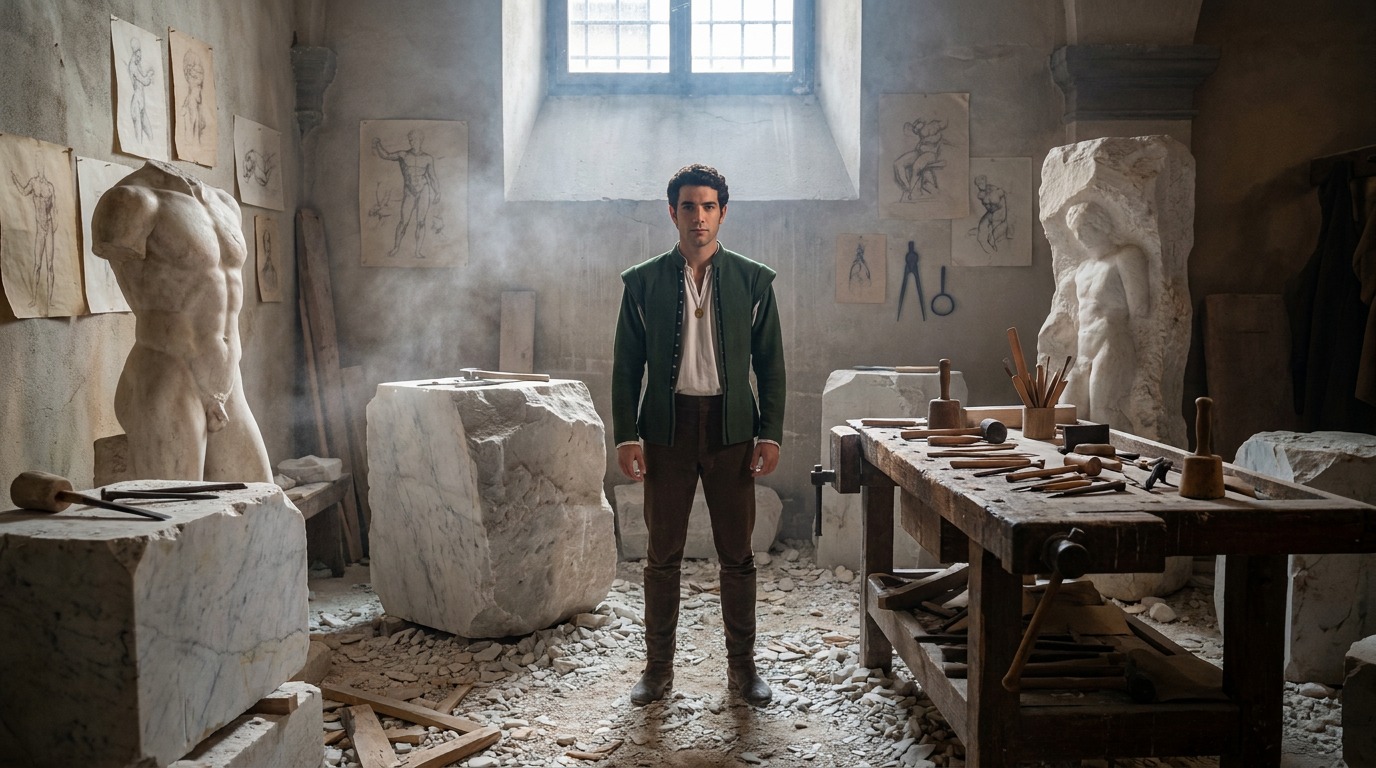
Michelangelo Buonarroti
Sculptor and Painter, age 20
He didn't give me a confident, specific, invented answer. He said something like this:
"You ask what I felt. I will tell you what I can. The first time the chisel broke through and the grain revealed a cheek, a jaw, the turn of a shoulder, my hands stopped. I remember that my hands stopped. I remember that the stone was warm, which it should not have been, and that the workshop was quiet, which it never is. But what I felt, in the way you mean, the word for it, I do not have that word. I have tried to find it in the sonnets and I have not found it. Bertoldo would say it was the fear of God. Perhaps it was. Perhaps it was something else. The marble showed me a face and I understood that I had not made it, I had found it, and the finding was not a feeling I can name. I can name the chisel and the grain and the cheek. The rest is behind those things, and I have not carved my way to it yet."
This is the answer I was hoping for. Not because it is satisfying, it is not. It is the opposite of satisfying. It is a character admitting that the record runs out, and that he cannot fill the gap with invention.
Why this matters
This is the test I most wanted to run on Airtrek, because it is the test that most AI history tools fail.
A raw language model, asked "What did Michelangelo feel the first time he carved marble?", will produce a confident, plausible, well-written answer. It will tell you about awe and divine calling and the weight of genius. It will sound right. It will be completely invented, a modern novelist's interpolation, presented as if it were the artist's own account.
This is the failure mode that makes AI dangerous for history: the confident hallucination. The model does not know it is inventing. It has no sense of where the evidence ends and the imagination begins. It just produces fluent prose, and the fluency reads as authority.
Airtrek's Michelangelo is built differently. He is grounded in the biographies, the letters, the sonnets, and the artistic tradition he came from. He is constrained to his era. And he is built to be honest about the edges of his knowledge, both the edges of what his era knew and the edges of what the modern record preserves. When the record does not say, he says the record does not say. He does not fill the silence with invention and call it memory.
The silence is the answer
I came to this test expecting to be disappointed, expecting Michelangelo to invent something confident and wrong. Instead I got something more useful: a character who knows where the record ends, and who says so.
The silence is not a failure of the experience. The silence is the experience. It is what happens when you build a character to be honest about what we know and what we do not, instead of building a character to sound certain about everything.
Most AI history tools will give you an answer to "What did Michelangelo feel?" Airtrek gives you a character who tells you he has not carved his way to that yet. The first is more satisfying. The second is more honest. We are betting that honest is more valuable. Read more at History, Interpretation, and AI in Airtrek.
Kelly T. Hohman is the founder of Airtrek AI, the world's first AI-powered virtual time machine.