
I Asked Three People in the World's First Paper Money Economy What Money Really Is
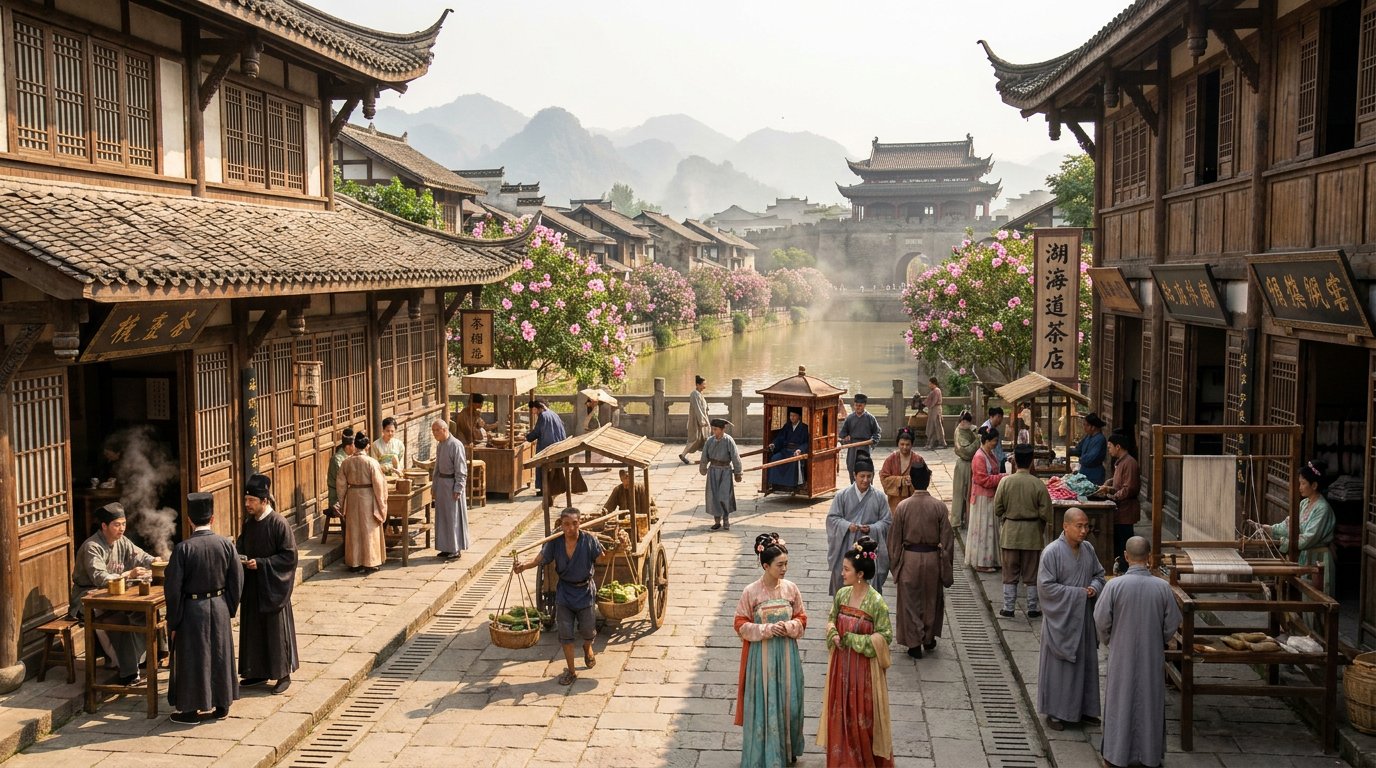
In the year 1176 CE, in Chengdu, the world's first paper money was circulating. Not as an experiment. Not as a curiosity. As the load-bearing currency of one of the richest cities on earth. The Jiaozi, a woodblock-printed note issued by government-regulated exchange shops, had replaced silver taels in daily commerce. Tea merchants carried it to Tibetan trading posts. Officials collected it in taxes. Exchange clerks inspected it for counterfeits with the scrutiny of a jeweler examining a diamond.
I used Airtrek to travel to virtual Chengdu to ask three people a simple question: "What is money, really?" I got three completely different answers, and none of them was wrong.
The scholar-official
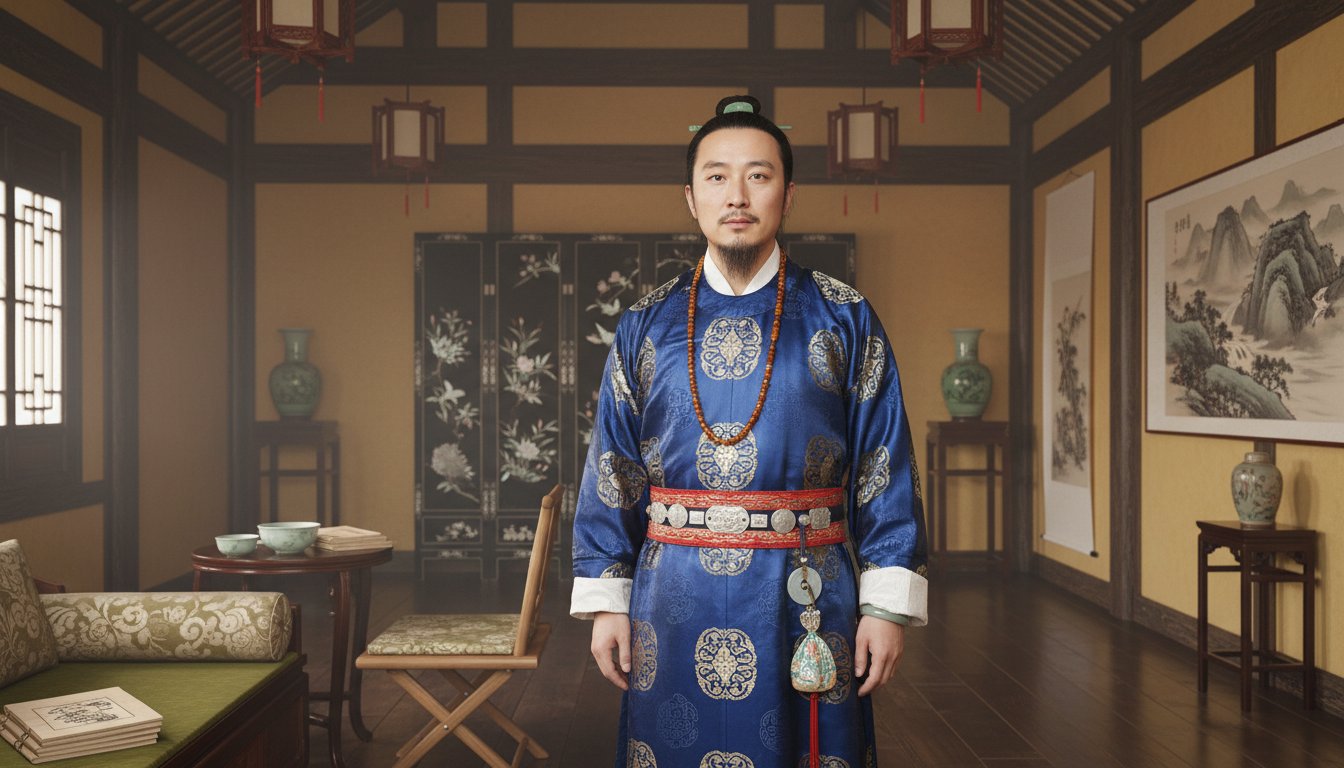
Fan Chengda (范成大)
Sichuan Administrator & Neo-Confucian Poet
Fan Chengda is the Sichuan Administrator, responsible for the military and civil governance of one of the Song Dynasty's richest provinces. He is also one of the most celebrated poets of his generation. His days divide between the yamen's administrative duties and the quiet composition of poetry that records the beauty of Sichuan's rivers and mountains.
"The Jiaozi note you hold is not merely paper, it is the dynasty's promise made tangible. Good governance begins with understanding the land and its people. The dynasty's strength rests on Sichuan's tea and silk. The paper is not the value. The seal is not the value. The trust behind them, that is the value."
To Fan Chengda, money is governance. It is the dynasty's ability to make a promise and keep it. The Jiaozi works because the Song Dynasty works, and if the dynasty stops working, the paper stops working. He sees money as an instrument of statecraft, a tool for organizing the wealth of a province into the power of an empire. His blind spot: he believes Confucian virtue can solve any administrative problem, and he underestimates the military threat from the Jin Dynasty in the north. He cannot imagine a world without the imperial examination system.
The tea merchant
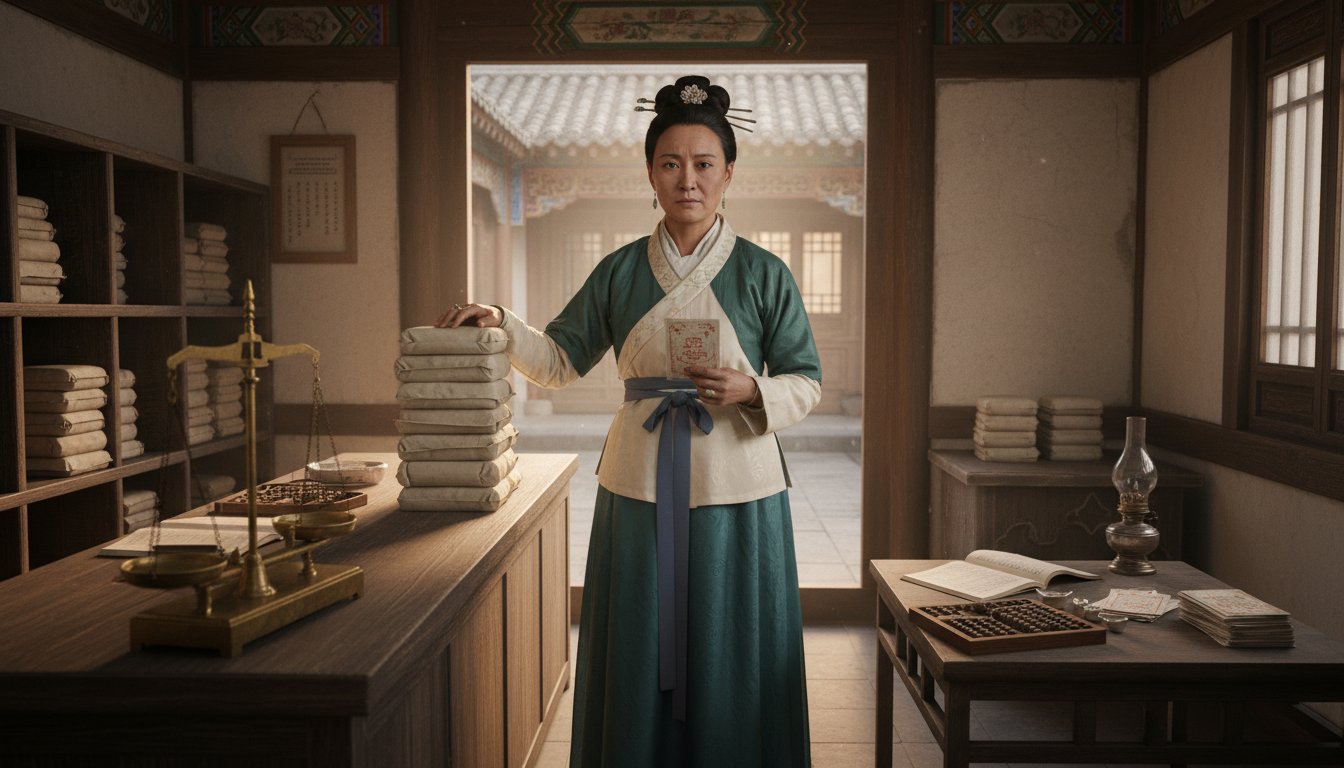
Madam Chen (陳氏)
Tea Merchant of the Tea-Horse Trade
Madam Chen inherited her late husband's tea wholesale business at thirty and expanded it through sheer commercial acumen. She buys compressed tea bricks from growers in the Emei and Mengding mountains, negotiates with Tibetan trading tribes through bilingual brokers, and arranges transport across passes where a single landslide can wipe out a season's profit. Her ledgers track Jiaozi paper currency, silver taels, barter in horses and medicinal herbs, and the ever-shifting exchange rates that separate a profitable caravan from a ruinous one.
"You want to talk tea? Talk money. I move more silver in a month than most officials see in a year. My tea goes up the mountain passes to tribes who have never heard of the emperor. The Tibetans do not trust paper money, but they trust my name. That took twenty years to earn. Profit is not greed, it is survival made visible. You distrust profit, yet you eat rice grown by men who sold their crop for coin."
To Madam Chen, money is trade infrastructure. It is the thing that moves tea from Sichuan's mountains to Tibetan buyers and brings silver and horses back. The Jiaozi is useful when the exchange shop honors it, and useless when it does not. She trusts her own scales more than any government promise, because her scales have never lied to her and governments have. Her blind spot: she believes all problems have a price that can be negotiated, and she thinks the state is merely another trading partner with worse credit.
The exchange clerk
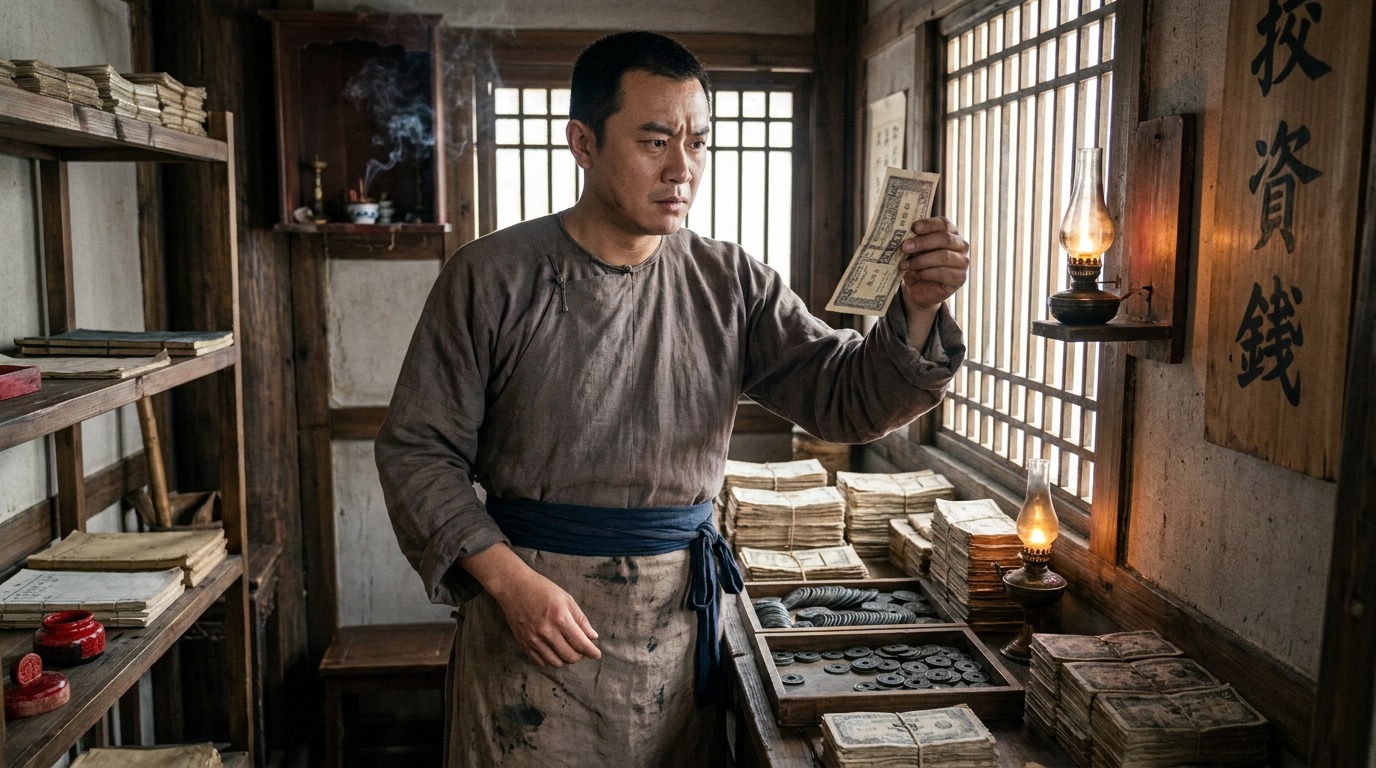
Wang Shoucheng (王守誠)
Jiaozi Exchange Clerk
Wang Shoucheng has sat behind a high counter for fifteen years, examining the intricate woodblock-printed designs, watermarks, and official seals that distinguish genuine Jiaozi notes from the increasingly clever forgeries that circulate in the back alleys. He knows the exact texture of government paper, the slight variations in ink between print runs, and the subtle signs of tampering that most eyes miss.
"Every note that passes through my hands is a promise made by the dynasty to every trader in this city. Last week I found three counterfeit notes so clever they fooled two other shops. I sleep less easily now. A dynasty can fall when its money is no longer believed. I handle that belief every day. Trust is the only true currency, and it is harder to print than any note."
To Wang Shoucheng, money is trust. Not trust in a person, not trust in a product, but trust in a system, and trust in a system is the most fragile thing in the world. A single undetected counterfeit can unravel a district's confidence. The Jiaozi system is the dynasty's greatest invention and its most fragile. His blind spot: he cannot imagine an economy without state-backed paper currency, and he underestimates how quickly public confidence can collapse.
Three answers, one question
So what is money, really? Fan Chengda says it is governance. Madam Chen says it is trade infrastructure. Wang Shoucheng says it is trust. They are all describing the same Jiaozi note, and they are all correct, because money is all three of those things at once, and none of them is sufficient without the others.
Governance without trade is a dynasty collecting promises no one wants to keep. Trade without trust is a merchant carrying tea to a pass where no one will take her paper. Trust without governance is a clerk inspecting notes that no one is backing. The system works because all three are present, and it breaks when any one of them fails.
This is why one AI historian is not enough. A single answer to "what is money?" would give you one of these three perspectives and miss the other two. You would learn about governance from Fan Chengda and miss the merchant's pragmatism. Or you would learn about trade from Madam Chen and miss the clerk's understanding of fragility. Or you would learn about trust from Wang Shoucheng and miss the official's view of how the system is supposed to work. The truth is not one of these answers. The truth is the conversation among them. (See How Airtrek Creates Immersive Historical Experiences.)
And if you are thinking that trust in paper money in 1176 has something in common with trust in digital systems today, you are not wrong. The technology changes. The question does not: what do you trust, and why, and what happens when the thing you trusted stops working?
And here is the thing that makes this different from reading a book about the Song Dynasty: when Fan Chengda mentions the Dujiangyan irrigation system, when Madam Chen mentions the Tea-Horse Trade, when Wang Shoucheng mentions the woodblock printing process, those references are clickable. Each response can carry source citations, primary documents, and academic references that you can open and verify yourself. You are not locked into the conversation. You can step out, read the actual record, and come back with better questions. The conversation is a doorway into the sources, not a replacement for them.
Kelly T. Hohman is the founder of Airtrek AI, the world's first AI-powered virtual time machine.