The Contradictions AI Smooths Over, We Make Them Clickable
I used Airtrek to travel to virtual Gilded Age New York and asked three people the same question: "Is this progress?" The railroad magnate said yes, without hesitation. The Irish immigrant servant said she didn't know. The Tammany Hall ward boss said progress is whatever keeps people fed.
Three people. One city. One question. Three different answers. None of them wrong.
That's not a bug. That's the point. And it's the thing every other AI system is designed to prevent.
The problem with one answer
Every AI system you've used is built to give you one answer. You ask a question, it synthesizes, it resolves, it gives you the consensus. The disagreement, the uncertainty, the perspectives that don't fit the summary, those get smoothed over. That's what "helpful" means.
The problem is that history isn't a consensus. It's a contradiction. The railroad magnate and the immigrant servant lived in the same city in the same year, and they experienced completely different Gilded Ages. A single answer to "what was the Gilded Age?" is not a simplification of the truth. It is a loss of it.
How Airtrek preserves contradiction
Airtrek doesn't give you one historian. It gives you the people who were there, each locked to their own time, place, and position. The magnate cannot see the tenement. The immigrant cannot see the boardroom. The ward boss sits between them and sees both, but is corrupted by the view.
They disagree with each other. They contradict each other. And you, the user, are the one who has to hold all three answers at once and decide what you believe. That's what critical thinking actually is, not being told the right answer, but being forced to weigh competing claims from people who each have partial access to the truth. (See Airtrek's Triad: The End of AI as Answer Machine for the philosophy behind this.)
Every claim is clickable
Here's the part that makes this different from a novel or a movie: every claim a character makes is traceable.
When Cornelius mentions the Brooklyn Bridge, when Bridget mentions the tenements, when Timothy mentions Tammany Hall, those references are clickable. Each character's response can carry source citations, primary documents, archaeological records, academic references, newspaper archives, photographs. You can open them. You can read the actual record. You can come back to the conversation with better questions.
You are not locked into the character's word. The character is a doorway into the sources, not a replacement for them. The contradiction is preserved, and the evidence is right there for you to check.
The gap we can't fill alone
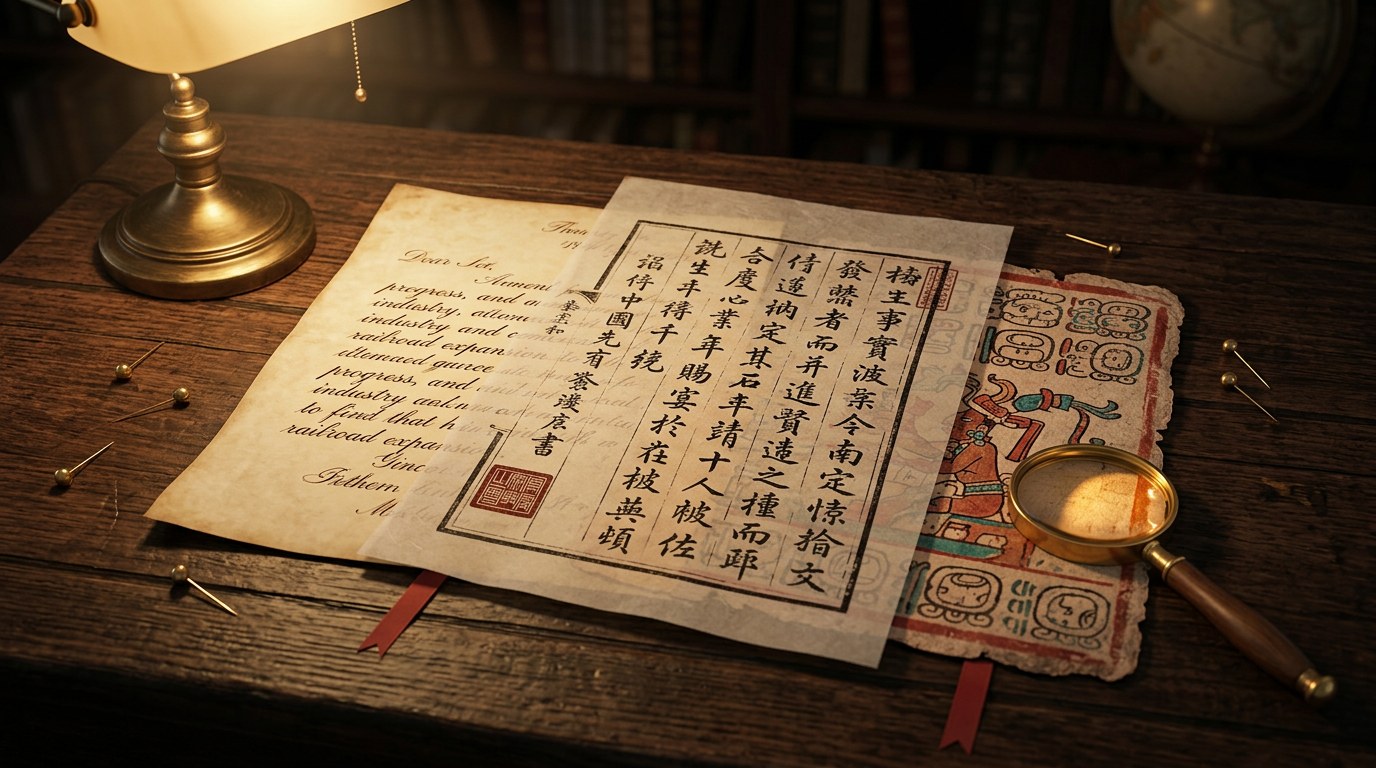
Here's the honest part. The eras we've built so far, Rome, Homeric Greece, Gilded Age New York, Song Dynasty Chengdu, Classical Maya Tikal, are eras where English-language scholarship is deep and accessible. We can build clickable references for those because the sources exist in databases we can reach.
Most of human history is not like that.
The Bhutanese concept of Gross National Happiness. Pre-colonial West African governance systems. Indigenous knowledge systems that sustained communities for millennia. The daily life of a woman in 14th-century Timbuktu. The agricultural calendar of a farmer in the Andes before the Spanish arrived. That knowledge exists, but it doesn't live in English-language archives. It lives in oral traditions, in community memory, in languages that AI doesn't speak, in the heads of people who are the last living inheritors of a practice their grandchildren may never learn.
We cannot build those eras from a training set. The data isn't there. And pretending we can would be exactly the kind of erasure we're trying to fix.
Hiring cultural experts as co-builders
So we're doing something different. We're hiring cultural experts, historians, knowledge keepers, and community members from the cultures we want to represent. Not as consultants who review our AI output after the fact. As co-builders who shape what the era contains, which characters exist, what they know, what they believe, and what sources back them up.
For the eras we've already built, this means deepening them. A Roman senator and a Roman merchant are a start, but Rome had enslaved people, freedmen, soldiers' wives, Syrian immigrants, Christians, Mithraists, and a hundred other positions that each saw a different city. Every character we add is another contradiction preserved.
For the eras we haven't built, this means starting from the people who actually hold the knowledge, not from a dataset. The characters, the sources, the clickable references, all of it comes from the community that lived it or inherited it.
You drive where we go next
You drive this. The eras we build next are the eras you ask for. If enough users want to visit 14th-century Timbuktu, we find the experts who can build it with us. If you want to see Heian Kyoto, or the Swahili Coast in 1300, or your own grandmother's village in 1940, that's where we go.
This is not a product roadmap we control. It's a community effort. You tell us where you want to go. We find the people who can take us there. The experts are compensated for their knowledge, because their knowledge is the scarcest resource in AI right now, and the people who hold it deserve to be paid for it.
The bet
Most AI gives you one answer and asks you to trust it. Airtrek gives you three contradictions and asks you to think. The sources are clickable. The experts are paid. The next era is the one you ask for.
That's the bet. Not AI that knows everything. AI that admits it doesn't, and gives you the tools to find out for yourself.
Unity through Wonder.
Kelly T. Hohman is the founder of Airtrek AI, the world's first AI-powered virtual time machine.