
Egypt Under Ramesses II Is Live: What the Ancients Knew That We Forgot
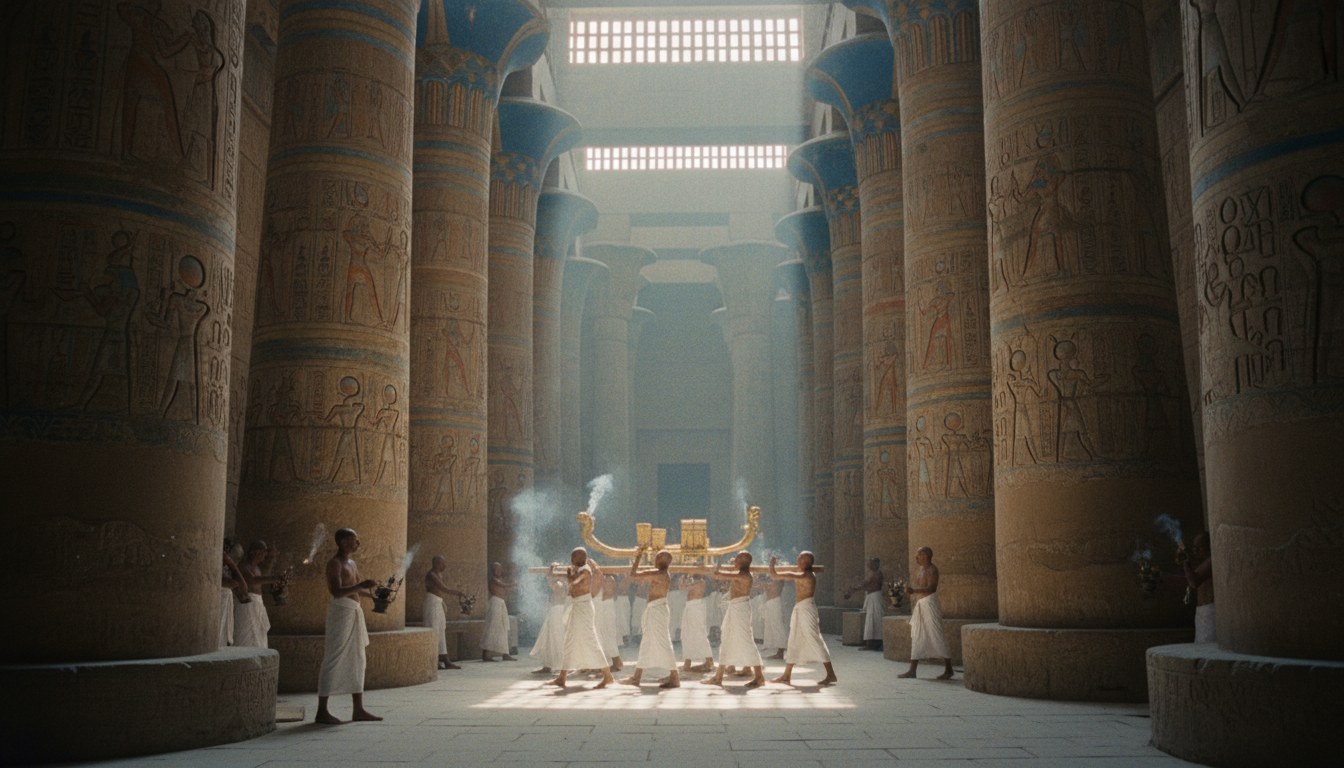
Egypt.... under Ramesses II is live at Airtrek.ai to challenge your conceptions of ancient life, and remind us of what the ancients knew that we have forgotten.
1. On Justice
We forgot that law was once a cosmic obligation, not a loophole game. They had Ma'at: truth, balance, order as a force of the universe. The vizier's court sat to maintain Ma'at, not to win. Past judgments were cited as precedent, contracts were witnessed and sealed, even the pharaoh was bound to uphold it. Ma'at operated as a principle, not a statute: justice = restoring balance; a crime = a tear in cosmic order; a judge's job = weigh impartially (literally, the scales metaphor); precedent + royal decree filled in where principle didn't.
2. On Medicine
We forgot that case-structured observation predates the scientific method by 3,000 years. The Edwin Smith Papyrus (c. 1600 BCE, copied from older sources) walks through 48 surgical cases, each with examination, diagnosis, treatment, and a verdict: "a condition I will treat" vs. "one I will not." The Ebers Papyrus carries 877 prescriptions. They got plenty wrong, but the structure: observe, classify, decide, is the skeleton of every modern clinical chart.
3. On Labor
We forgot that organized workers struck 3,000 years before the Industrial Revolution. The Turin Strike Papyrus records the Deir el-Medina tomb workers downing tools under Ramesses III (c. 1156 BCE): wages were late, and they walked off, writing they were "hungry and thirsty." A planned worker village, uniform housing, rations, a grievance process, and a strike. The "modern" labor dispute is an ancient one. The pyramids weren't built by whipped anonymous masses; they were built by a logged, housed, fed, and accountable workforce.
4. On Engineering
We forgot that the most resilient machines use no fuel. The shaduf: a counterweighted lever, a bucket, a rope. One person lifts water from a lower canal to a higher field all day, for centuries: no engine, no grid, no supply chain. Nilometers measured the flood to 16 cubits at Memphis and predicted feast or famine. And they were built to last thousands of years.
5. On the Circular Economy
We forgot that "zero waste" is how a civilization survives a desert. One plant, papyrus, became paper, boats, baskets, rope, sandals, and ship caulking. Oils and resins became fragrance, medicine, and embalming. Bees gave food, wound dressings, and preservation. The Nile gave transport, irrigation, and silt in one annual event. Nothing had one use.
Kelly T. Hohman is the founder of Airtrek AI, the world's first AI-powered virtual time machine.