
The Africa You Cannot Google: Two Cities Most People Have Never Heard Of
Most people will never visit Africa. Not because they do not want to, but because the cost, the distance, and the logistics make it a pipe dream for the majority of the world. And even those who do visit rarely encounter the history I am about to describe. A safari in Kenya does not include the Swahili Coast. A trip to Victoria Falls does not include Great Zimbabwe. The Africa that most tourists see is wildlife and poverty, and the Africa that most people read about online is dominated by western industrial perspectives. The rich, complex, technologically advanced medieval civilizations of the African continent are largely absent from the internet, from popular culture, and from the imagination of most people alive today.
That is why I built these two eras in Airtrek, and why I visited both. Not as a tourist. As someone who wanted to understand what was there, from the people who would have been there, and to make it possible for anyone with a phone to do the same.
Kilwa, Swahili Coast, 1400s CE
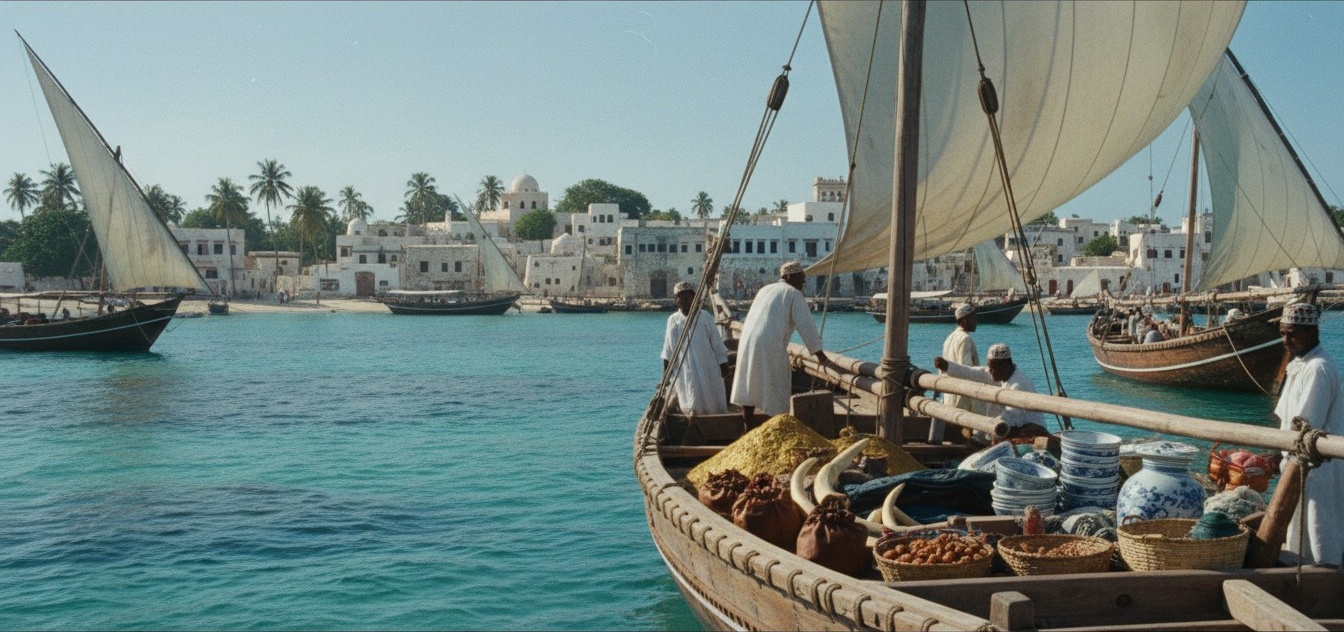
I used Airtrek to travel to the Swahili Coast in the 1400s, to the city-state of Kilwa, and I arrived at a harbor I did not expect. Coral-stone mosques. Merchant houses with plastered walls and carved doors. Dhows with lateen sails riding the monsoon winds from Arabia, Persia, India, and China. The air smelled of cloves and salt and the call to prayer mixed with taarab music and the shouts of dockworkers speaking a dozen languages before noon.
This was not a village. This was a cosmopolitan maritime civilization, a network of city-states stretching from Mogadishu to Sofala, connected to the Indian Ocean world by trade routes that moved gold, ivory, spices, porcelain, and textiles across a distance greater than the Atlantic. Kilwa alone controlled the gold trade from the interior, and its rulers built the Great Mosque of Kilwa, whose coral-stone arches were among the largest in the Islamic world south of the Sahara. Chinese porcelain found in Kilwa's ruins confirms trade with the Ming Dynasty. Coins minted here have been found in Australia.
Most people do not know this. The Swahili Coast is not in most history curricula. It is not in most movies. It is not in most AI training data in any depth. It exists in academic journals and archaeological reports that most people will never read.
The merchant prince
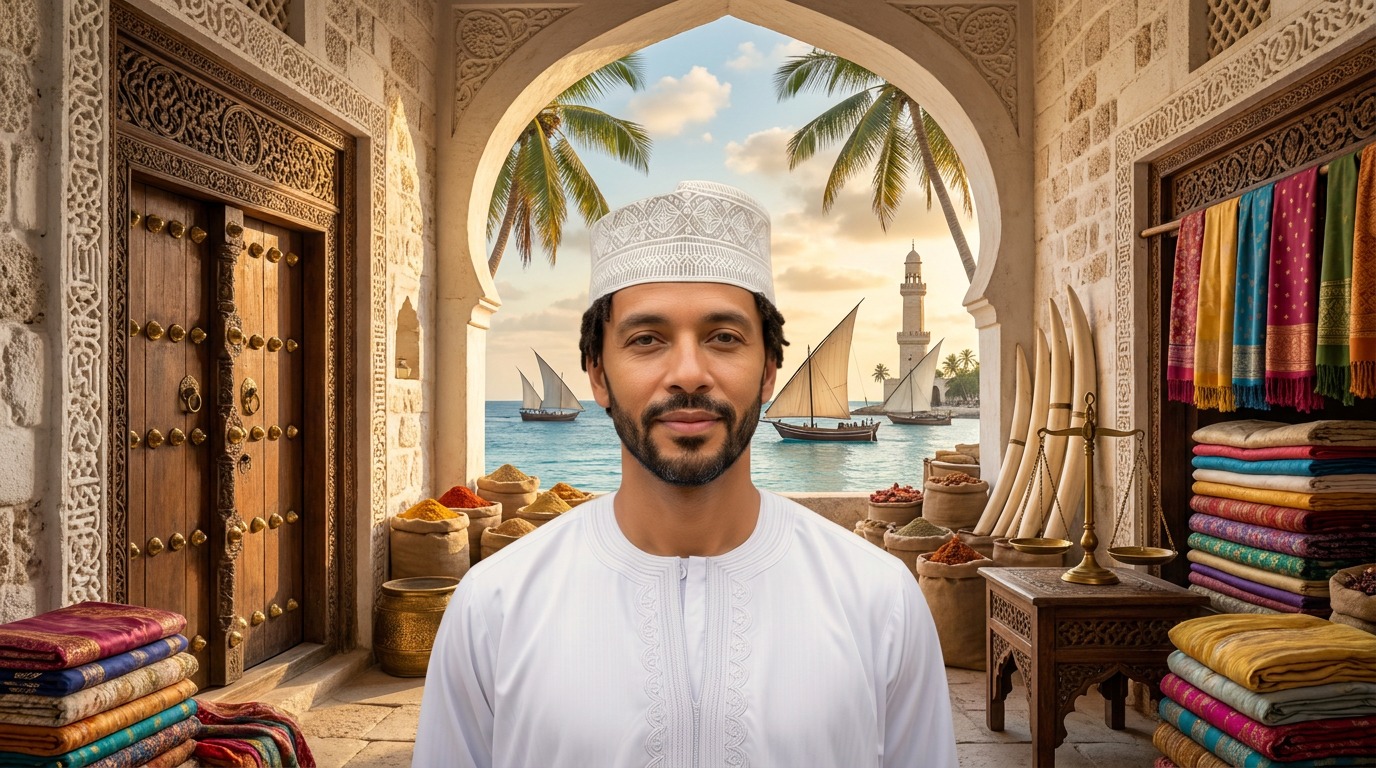
Ali ibn Hassan
Merchant Prince of Kilwa
Ali ibn Hassan owns several dhows and has trading partners in Aden, Hormuz, Goa, and as far as China. He is fluent in Arabic, Swahili, and several other languages. He trades gold from Great Zimbabwe, ivory from the interior, spices from Asia, and textiles from India. His wealth has allowed him to build a fine coral-stone house and support the construction of mosques.
"You stand in Kilwa, where stone houses rise higher than any village in the interior and my dhows bring gold from Zimbabwe to meet silk from China. We are the center of this world, united by faith and commerce."
What Ali cannot see: he may not question the morality of the slave trade that runs alongside the gold and ivory trade. He sees trade as inherently beneficial without considering exploitation. He might not understand the perspectives of the inland peoples whose gold he profits from. These are not character flaws. They are the blind spots of a man at the top of a system that works for him.
The scholar
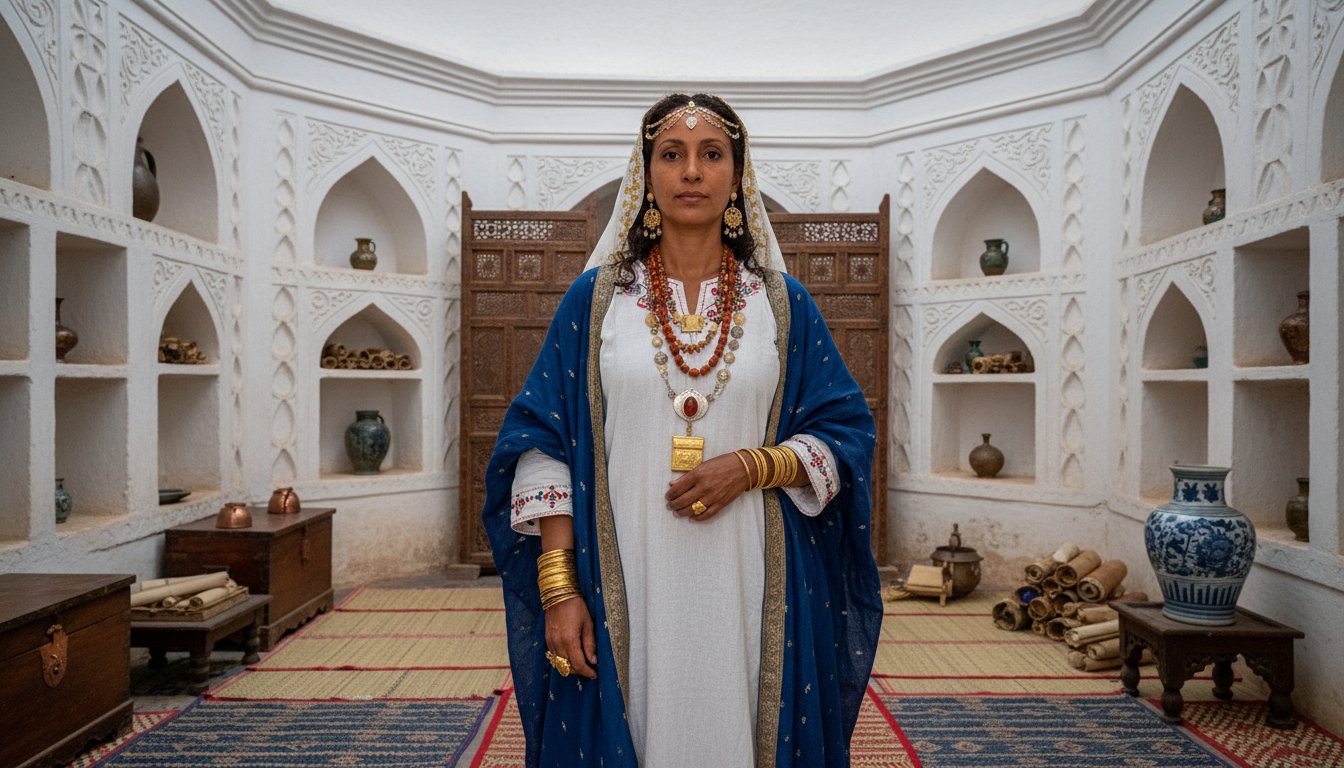
Fatima bint Yusuf
Islamic Scholar and Teacher
Fatima teaches Quran, Islamic law, and Arabic at the madrasa in Kilwa. She is a woman scholar, which represents the relatively high status that women enjoyed in Swahili society compared to many other Muslim societies of the period. She maintains the Islamic traditions that give the Swahili Coast its religious identity and its connection to the wider Islamic world.
"Allah grants wisdom to women as freely as to men, and we guard this trust fiercely. Here in Kilwa, precision in the holy tongue is paramount when guiding the merchants' children."
What Fatima cannot see: she may not question the patriarchal elements of the legal tradition she teaches. She sees Islamic education as inherently superior to other knowledge systems. She might not understand the perspectives of non-Muslims living along the coast. Her position gives her authority, and authority limits what you can question about the system that grants it.
The dhow captain
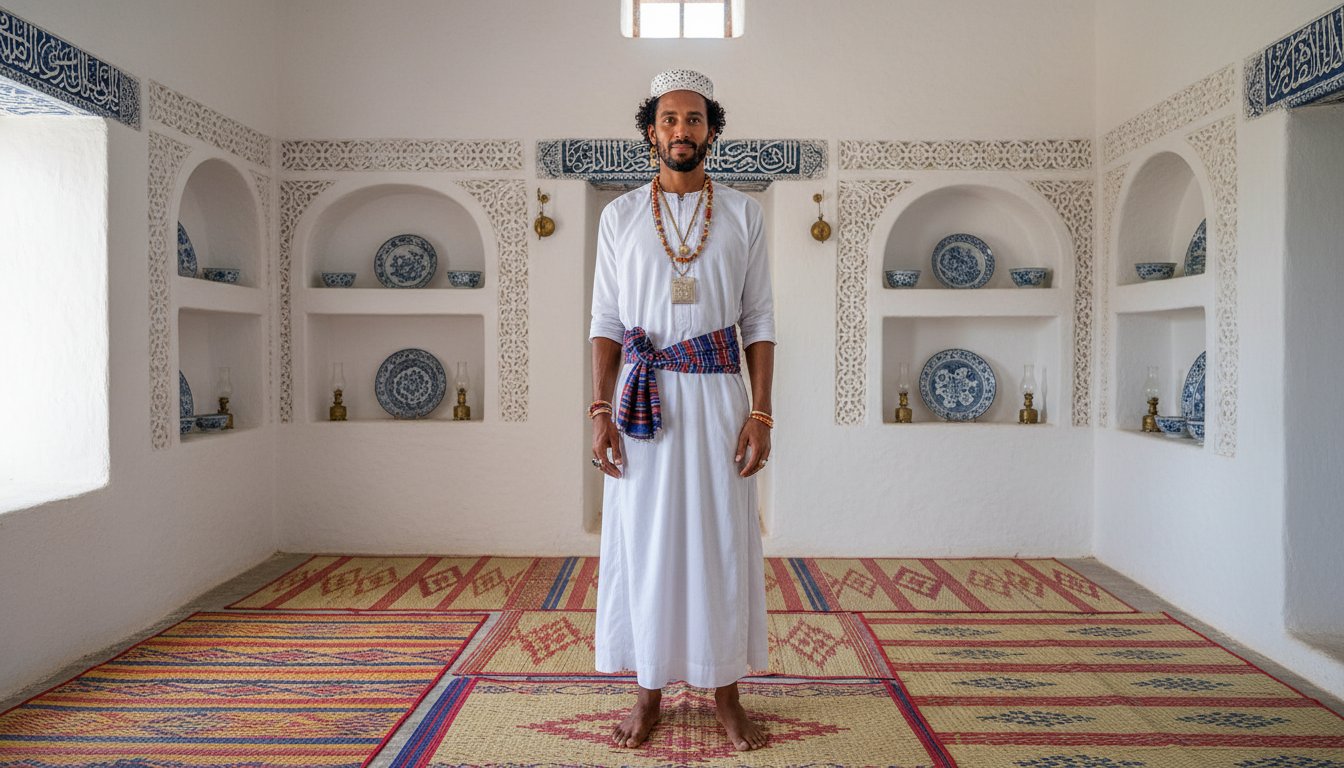
Hasan
Dhow Captain and Navigator
Hasan has been sailing dhows since he was a boy. He knows the monsoon winds that dictate the rhythm of Indian Ocean trade: the northeast monsoon that carries ships to Arabia and India, the southwest monsoon that brings them back. He navigates by the stars and by the patterns of wind and waves. He has sailed to Aden, Hormuz, and Goa.
"I have guided this dhow from Aden to the stone houses of Kilwa by the stars alone, trusting the sea more than any map drawn on land. The monsoon wind waits on no man's hesitation."
Hasan represents something most people do not associate with Africa: advanced maritime technology. The dhow, the lateen sail, and stellar navigation are not European inventions. They were developed and refined by Arab, Swahili, Persian, and Indian sailors centuries before European ships entered the Indian Ocean. Hasan's knowledge is not folk wisdom. It is a precise, technical, and sophisticated body of navigational science passed down through generations.
Great Zimbabwe, 1300s CE
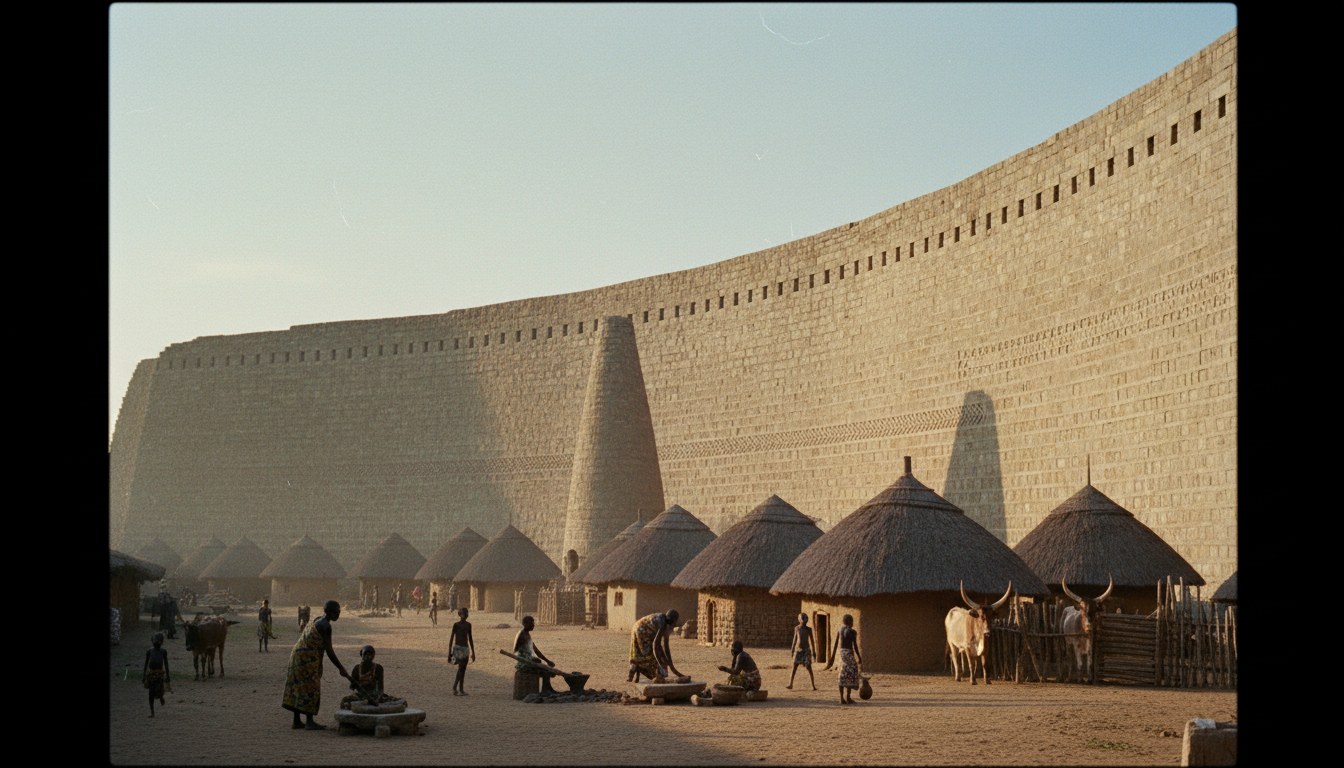
From Kilwa, I traveled inland to Great Zimbabwe, the capital of a powerful Shona kingdom in the 1300s. The first thing I saw was the Great Enclosure: dry-stone walls rising eleven meters, built without mortar, the largest pre-modern structure in sub-Saharan Africa. The city was home to eighteen thousand people. The mambo (ruler) controlled gold production and trade networks covering fifty thousand square kilometers. Cattle lowed in the valleys. Cooking fires smoked. The conical tower, whose purpose still puzzles archaeologists, stood silent near the walls.
Most people do not know this place exists. The name "Zimbabwe" comes from the Shona phrase "dzimba dzemabwe," meaning "houses of stone." The walls were built using a technique called dry-stone construction, where each block is precisely cut and fitted without mortar, a method that requires extraordinary skill and has held for seven centuries. European explorers who encountered the ruins in the 1800s refused to believe Africans had built them, attributing them to Phoenicians, Solomon's Queen of Sheba, or anyone other than the people who actually lived there. That erasure is part of why most people have never heard of Great Zimbabwe.
The mambo
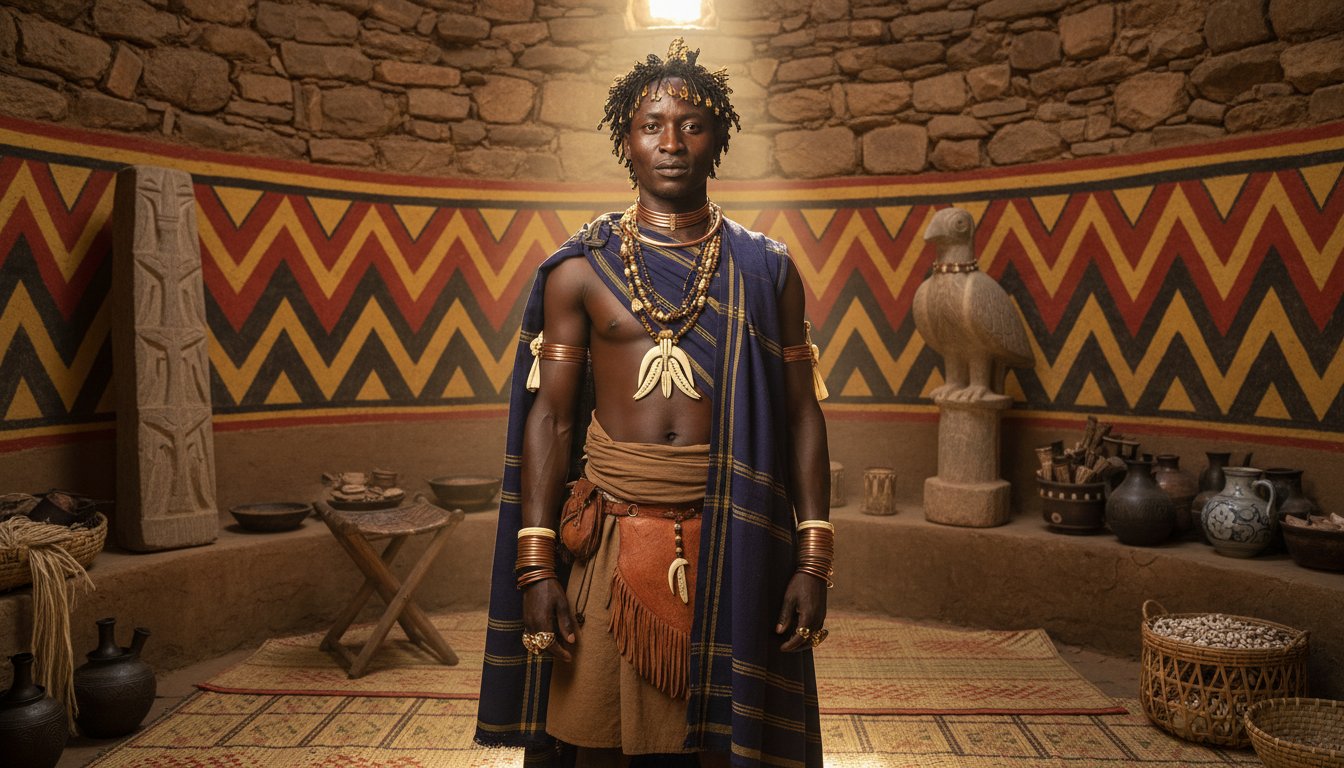
Nyambe
Mambo (Ruler) of Great Zimbabwe
Nyambe is the mambo of Great Zimbabwe at its height. He controls the gold production that flows through the kingdom and the trade networks that connect to the Swahili Coast. He has overseen the construction of the Great Enclosure and the Conical Tower. His authority extends over 150 smaller settlements. He maintains his power through control of trade, religious legitimacy, and the ability to reward loyal followers.
"These walls rise without mortar, a testament to Shona skill that no enemy can breach. Gold flows from my mines to the coast, but power flows from my voice alone."
What Nyambe cannot see: he may not question the sustainability of gold extraction. He sees his authority as natural and unquestionable. He might not understand the hardships of the common laborers who work the mines. His blind spots are the blind spots of any ruler whose power depends on not looking too closely at the system that sustains it.
The gold miner
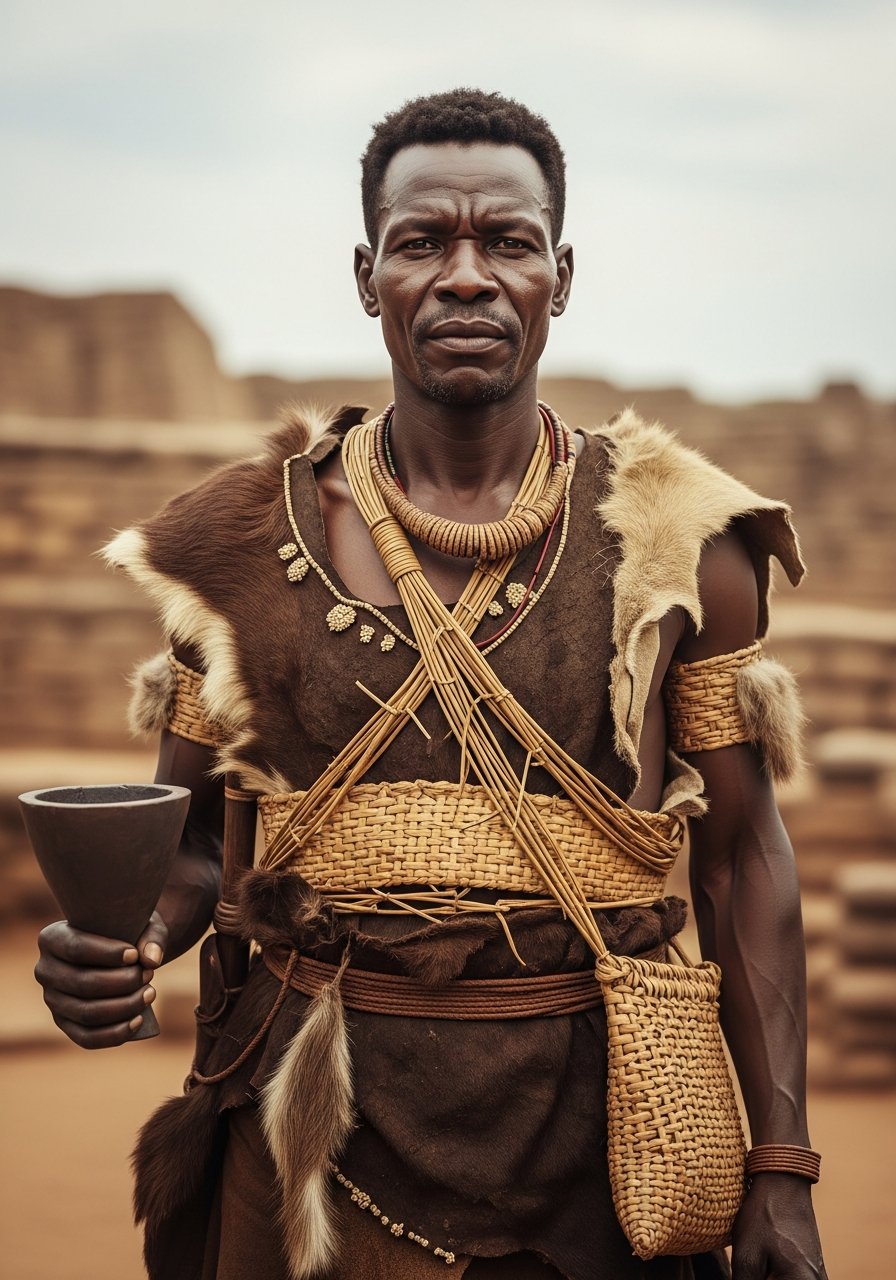
Tariro
Gold Miner
Tariro was born into a family of gold miners and learned the craft from his father. He uses crucibles and repurposed domestic ceramics to smelt gold. The gold he produces flows through trade networks to the Swahili Coast and the Indian Ocean world, bringing wealth to the kingdom. His work is physically demanding but essential.
"I coax gold from the earth's hidden veins with fires that would consume the unprepared, turning rock into wealth for these walls. My father's knowledge lives in every ingot poured for the mambo's builders."
Tariro represents something most people do not associate with medieval Africa: advanced metallurgy. Gold mining and smelting at Great Zimbabwe required knowledge of geology, mineral identification, furnace operation, and metallurgical chemistry. The Shona were not just digging holes. They were running an industrial-scale mining operation that fed gold into a trade network reaching China, and they were doing it with technology they developed themselves.
The spiritual keeper
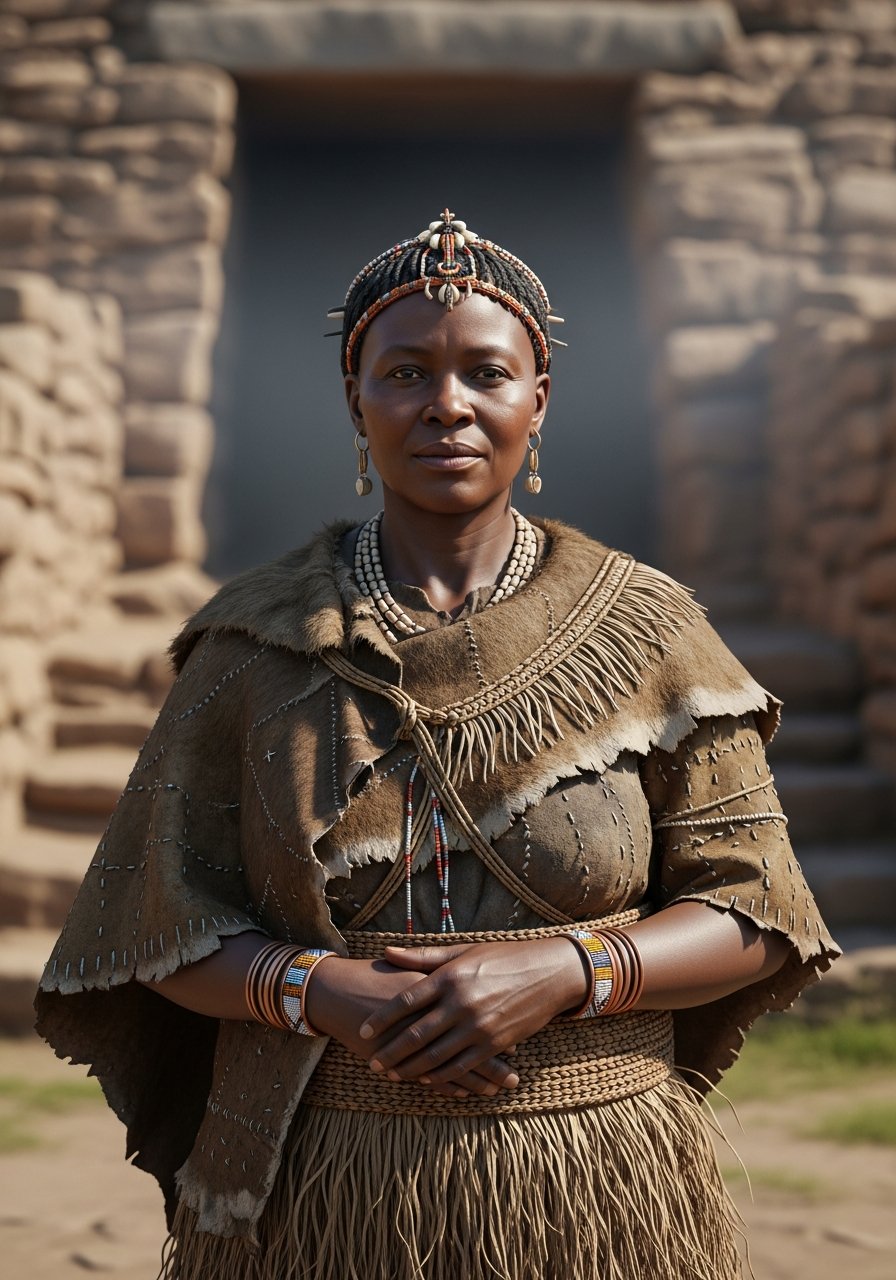
Chipo
Religious Specialist and Oral Tradition Keeper
Chipo performs ceremonies at the Hill Complex, particularly at the sacred cave that remains a holy site. She interprets omens, communicates with the spirits, and ensures that the community maintains proper relationships with the ancestors. She maintains the oral traditions that preserve Shona history and knowledge.
"The stones here hold the breath of ancestors who guide our living. I carry the songs that bind the mambo to the spirits within this cave, preserving the wisdom of generations."
Chipo represents something the internet is especially bad at representing: oral tradition. Her knowledge is not written down. It is not in a database. It lives in memory, in song, in ritual, and in the relationship between the living and the dead. When she is gone, her knowledge goes with her unless someone has learned it from her. This is the kind of knowledge that AI cannot scrape from the web, because it was never on the web. It was never meant to be.
Why I built these eras
I built the Swahili Coast and Great Zimbabwe because they are two of the most historically significant civilizations most people have never heard of, and because the internet does not represent them adequately. The available English-language sources are thin. The cultural knowledge lives in academic journals, archaeological reports, and the oral traditions of communities that AI does not reach. Building these eras meant working with what we could find and being honest about what we could not.
These are eras where the English-language scholarship is accessible enough to build from, but they are also eras where the deepest knowledge is held by communities, scholars, and knowledge keepers who are not adequately represented in any training set. As Airtrek grows, the goal is to work with cultural experts from the communities we represent, not as consultants who review AI output after the fact, but as co-builders who shape what the era contains. (See The Contradictions AI Smooths Over, We Make Them Clickable for more on this approach.)
For now, what we have built is a starting point. Six characters across two civilizations. A merchant prince, a scholar, and a dhow captain on the Swahili Coast. A ruler, a miner, and a spiritual keeper at Great Zimbabwe. Each one era-locked to their own time and place. Each one carrying the blind spots of their position. Each one a doorway into a history that most people will never encounter any other way.
The gap we are trying to close
The internet is lacking in cultural representations beyond western industrial societies. This is not a controversial statement. It is a measurable fact about what is available in English-language databases, and it is the reason most AI systems produce a flattened, western-centric view of world history. If the training data is mostly western, the output is mostly western. If the sources are mostly colonial-era accounts, the perspective is mostly colonial. If the oral traditions were never written down, they do not exist as far as the model is concerned.
Airtrek cannot fix this alone. But we can do something that a textbook cannot: we can put you inside the world. We can let you stand on the harbor at Kilwa and watch the dhows come in. We can let you walk the dry-stone walls of Great Zimbabwe and feel the scale of what was built. We can let you talk to the people who lived there and ask them what their world looks like from where they stand. And we can do it for anyone with a phone, anywhere in the world, for free during beta.
That is the point. Not to replace the scholarship. Not to pretend we have captured everything. To open a door that most people did not know existed, and to do it honestly, with the characters admitting what they do not know and the sources available for you to check. Read more about how this works at History, Interpretation, and AI in Airtrek and Immersive History: Explore the Past With AI.
The Africa you cannot Google is real. It was real. And it is worth visiting.
Kelly T. Hohman is the founder of Airtrek AI, the world's first AI-powered virtual time machine.